
Systematic Literature Review: A Step-by-Step Guide
 November 27, 2026
 7 min read





Table Of Content
- What Is a Systematic Literature Review?
- Systematic Literature Review vs. Research Literature Review
- Why Conduct a Systematic Literature Review?
- Step-by-Step Guide to a Systematic Literature Review
 Key Insights
- A systematic literature review follows a structured and repeatable process to identify, evaluate, and analyse relevant studies, reducing bias and improving transparency.
- Unlike a traditional research literature review, a systematic review uses a focused research question, documented search strategies, predefined selection criteria, and formal quality assessments.
- Conducting a systematic literature review involves nine key steps, from defining the research question and developing a review protocol to synthesising findings and reporting results.
- Tools such as Zotero, Mendeley, EndNote, Rayyan, and established quality assessment checklists help organise references, screen studies, and evaluate research reliability.
- In this blog, you'll learn what a systematic literature review is, why it matters, how to conduct one in nine steps, and how a practical literature review example can help you understand the process.
Researchers, students, and professionals often face the same challenge: how to make sense of a large and growing body of published studies. Reading a few articles and summarizing them is rarely enough when a decision, a thesis, or a policy depends on the evidence. This is where a systematic literature review becomes valuable.
A systematic literature review follows a clear, repeatable method to find, evaluate, and combine the best available evidence on a specific question. This blog explains what it is, how it differs from a general research literature review, and how to complete one in nine practical steps. It also includes a literature review example and answers to common questions.
 ChatGPT
 Perplexity
 Claude
 Grok
What Is a Systematic Literature Review?
A systematic literature review is a structured method of collecting and analyzing all relevant studies on a defined research question. Instead of choosing sources informally, the researcher sets rules in advance for how studies will be searched for, selected, assessed, and summarized. These rules are documented so that another person could follow the same process and reach similar results.
This approach reduces bias and increases transparency. It is widely used in medicine, education, psychology, social sciences, business, and engineering. Because the process is rigorous, a well-conducted systematic literature review is often considered one of the most reliable forms of evidence, and it can guide clinical practice, policy decisions, and future research.
Systematic Literature Review vs. Research Literature Review
Many people use the terms interchangeably, but they are not identical. A research literature review, sometimes called a narrative or traditional review, gives an overview of existing knowledge on a topic. The author selects sources based on relevance and expertise, then discusses themes, debates, and gaps. It is flexible and works well for introducing a topic or framing a study.
A systematic review, in contrast, follows a strict protocol and aims to be comprehensive and unbiased. The main differences include:
- Question: A systematic review addresses a narrow, focused question, while a traditional review may cover a broad topic.
- Search: A systematic review uses documented search strategies across multiple databases.
- Selection: Inclusion and exclusion criteria are set before screening begins.
- Quality checks: Each study is formally appraised for reliability.
- Reporting: Every decision is recorded so the process can be reproduced.
Both types are useful. The right choice depends on your purpose, your resources, and the expectations of your institution or journal.
Why Conduct a Systematic Literature Review?
There are several strong reasons to undertake this type of study. It summarizes large amounts of evidence into a single, accessible source. It identifies gaps where more research is needed, and it highlights inconsistencies between studies. It also prevents duplicated effort by showing what has already been investigated. For students, it demonstrates a deep understanding of the field. For professionals, it supports evidence-based decisions.
Step-by-Step Guide to a Systematic Literature Review
The following nine steps provide a practical roadmap. Although the details vary by discipline, the overall logic remains the same.
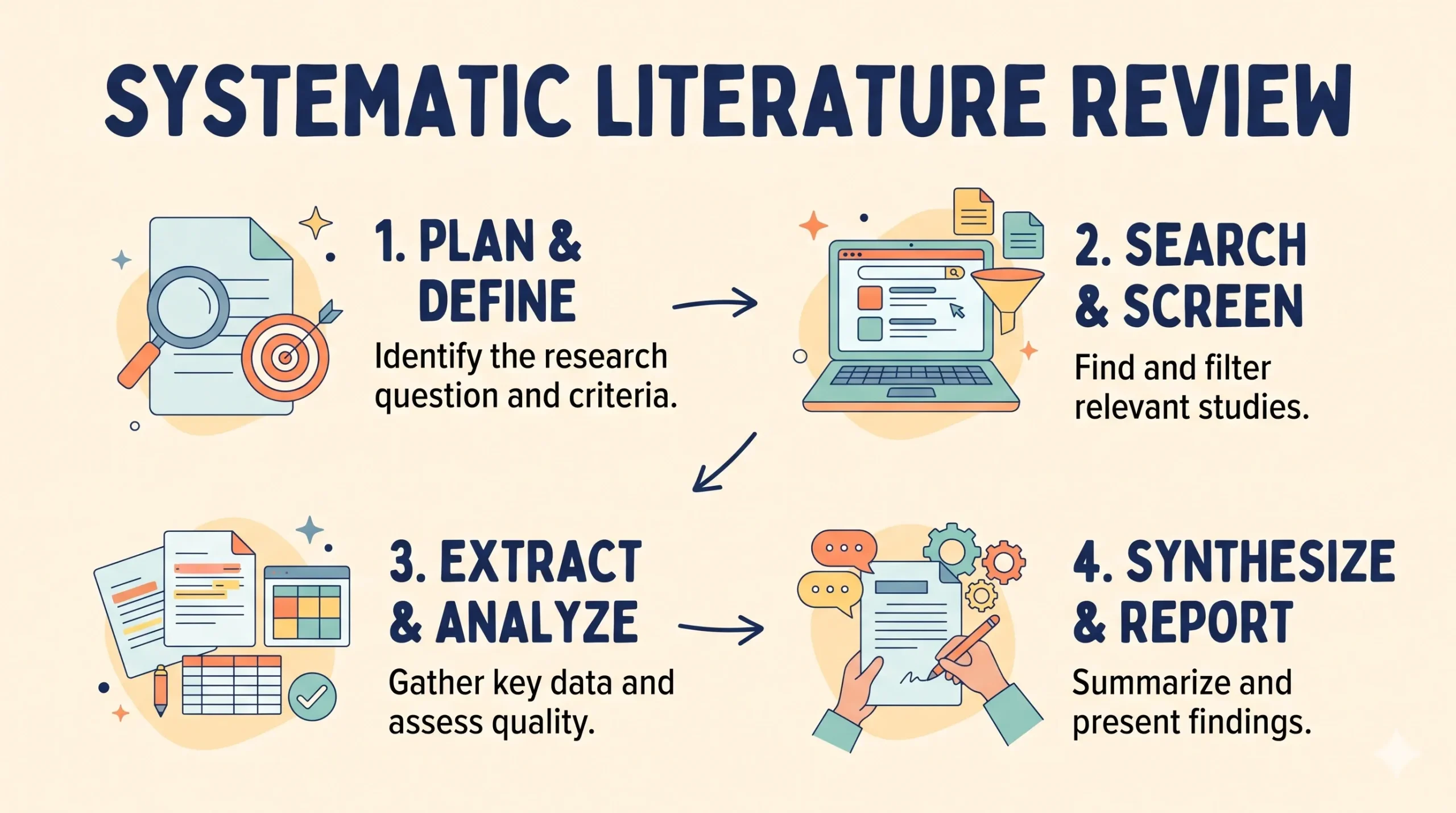
Step 1: Define Your Research Question
Every systematic literature review begins with a clear, answerable question. A vague question leads to an unmanageable number of results, while an overly narrow one may return too few studies. Frameworks can help. In health research, the PICO model considers the Population, Intervention, Comparison, and Outcome. In other fields, you might use similar structures such as SPIDER or PICOS. Write your question in one sentence, and test it with a colleague or supervisor before moving forward.
Step 2: Develop a Review Protocol
A protocol is your written plan. It states the research question, search methods, selection criteria, quality assessment tools, and the way data will be analyzed. Creating the protocol before you begin prevents decisions from being shaped by the results you happen to find. Many researchers register their protocols publicly, for example, on PROSPERO or the Open Science Framework, which adds credibility and avoids duplication.
Step 3: Set Inclusion and Exclusion Criteria
Inclusion and exclusion criteria determine which studies belong in your review. Common factors include publication years, languages, study designs, participant characteristics, and types of outcomes. For example, you might include only peer-reviewed randomized controlled trials published in English since 2015. Be specific and consistent. Clear criteria make screening faster and protect your review from accusations of selective reporting.
Step 4: Design and Run a Comprehensive Search
The search is the foundation of a good systematic literature review. Identify keywords and synonyms related to each part of your question, and combine them using Boolean operators such as AND, OR, and NOT. Search several databases, such as PubMed, Scopus, Web of Science, ERIC, or PsycINFO, depending on your field. Also check reference lists and consider gray literature, including reports and theses. Record the databases, dates, and exact search strings so the process can be repeated.
Step 5: Screen the Studies
Screening happens in two stages. First, review titles and abstracts to remove clearly irrelevant studies. Second, read the full text of the remaining articles and apply your criteria carefully. Ideally, two reviewers work independently and resolve disagreements through discussion. Reference managers such as Zotero, Mendeley, or EndNote, and screening tools like Rayyan, can simplify the task. Track the number of studies at each stage, as this information is usually presented in a PRISMA flow diagram.
Step 6: Extract the Data
Data extraction means collecting key information from each included study in a consistent format. Typical details include authors, year, country, sample size, methods, main findings, and limitations. Create a standard extraction form or spreadsheet and test it on a few studies first. Consistent extraction makes comparison easier and reduces errors, especially when more than one person is involved.
Step 7: Assess the Quality of Included Studies
Not all studies are equally trustworthy. Quality assessment, sometimes called risk-of-bias evaluation, examines whether a study’s design and execution support its conclusions. Established tools include the Cochrane Risk of Bias tool, the Joanna Briggs Institute checklists, and the CASP checklists. Use the tool that fits your study designs, and explain how quality ratings influenced your interpretation of the findings.
Step 8: Synthesize the Findings
Synthesis brings the evidence together. If the studies are similar enough, you may combine results statistically in a meta-analysis. When they differ widely in methods or outcomes, a narrative or thematic synthesis is more appropriate. Group studies by theme, population, or outcome, and look for patterns, contradictions, and gaps. Present your findings with tables and figures where possible, because they help readers see the evidence at a glance.
Step 9: Write and Report the Review
Finally, write the review using a clear structure: introduction, methods, results, discussion, and conclusion. Follow the PRISMA 2020 guidelines to ensure complete reporting. In the discussion, explain what the evidence means, acknowledge limitations, and suggest directions for future research. Write in plain, precise language, and avoid overstating conclusions that the evidence does not fully support.
Literature Review Example: A Simple Illustration
A concrete literature review example can make the process easier to understand. Imagine a graduate student who wants to study whether mobile learning apps improve vocabulary retention among high school students.
The student begins with the question: “Do mobile learning apps improve vocabulary retention in high school students compared with traditional classroom methods?” The protocol sets inclusion criteria, such as peer-reviewed studies from 2015 to 2025 that involve students aged 14 to 18 and measure vocabulary outcomes. Searches in ERIC, Scopus, and Web of Science produce 640 records. After removing duplicates, 480 titles and abstracts are screened, and 52 full-text articles are read. Eventually, 18 studies meet all criteria.
The student extracts data from each study, assesses quality with a standard checklist, and groups results by app type and study length. The synthesis shows that most studies report modest improvements, especially when apps are used regularly alongside teacher guidance. The review also finds few long-term studies, which highlights a clear gap for future research. This is a simplified scenario, but it shows how each step leads logically to the next.
Conclusion
A systematic literature review is a powerful way to turn scattered studies into reliable, usable knowledge. By defining a precise question, following a written protocol, searching widely, screening carefully, appraising quality, and reporting transparently, you create a review that others can trust and build upon.
The process requires time and patience, but the reward is a thorough understanding of your topic and a strong contribution to your field. Start small, follow the steps in order, and use the available tools and guidelines. With practice, completing a high-quality research literature review becomes far more manageable.
Frequently Asked Questions
The duration depends on the scope of the question, the number of studies, and the size of the team. Many reviews take between six months and a year, although smaller projects may be completed sooner. Careful planning and the use of screening software can shorten the timeline.
Yes, AI-assisted tools can support tasks such as removing duplicates, screening abstracts, and organizing references. However, researchers remain responsible for decisions about inclusion, quality, and interpretation. Always verify the output of any automated tool and report how it was used.
A systematic review is the overall process of identifying and evaluating studies on a question. A meta-analysis is an optional statistical technique within a review that combines numerical results from similar studies. Not every systematic review includes a meta-analysis, particularly when the studies are too different to combine.

Related Courses
Explore our programs







Find a Program made just for YOU
We'll help you find the right fit for your solution. Let's get you connected with the perfect solution.

Is Your Upskilling Effort worth it?
 ROI Calculator


Are Your Skills Meeting Job Demands?
Try our Skill Gap tool
Experience Lifelong Learning and Connect with Like-minded Professionals
Explore Jaro Connect
