What Is Public Private Partnership? A Simple Explanation
Key Features of a Public Private Partnership
Common Types of Public Private Partnership Models
Key Insights
Public Private Partnership (PPP) is a long-term agreement between a government body and a private company to finance, build, operate, or maintain public assets and services.
Common PPP models include Build-Operate-Transfer (BOT), Build-Own-Operate-Transfer (BOOT), Design-Build-Finance-Operate (DBFO), lease and concession models, and the Hybrid Annuity Model.
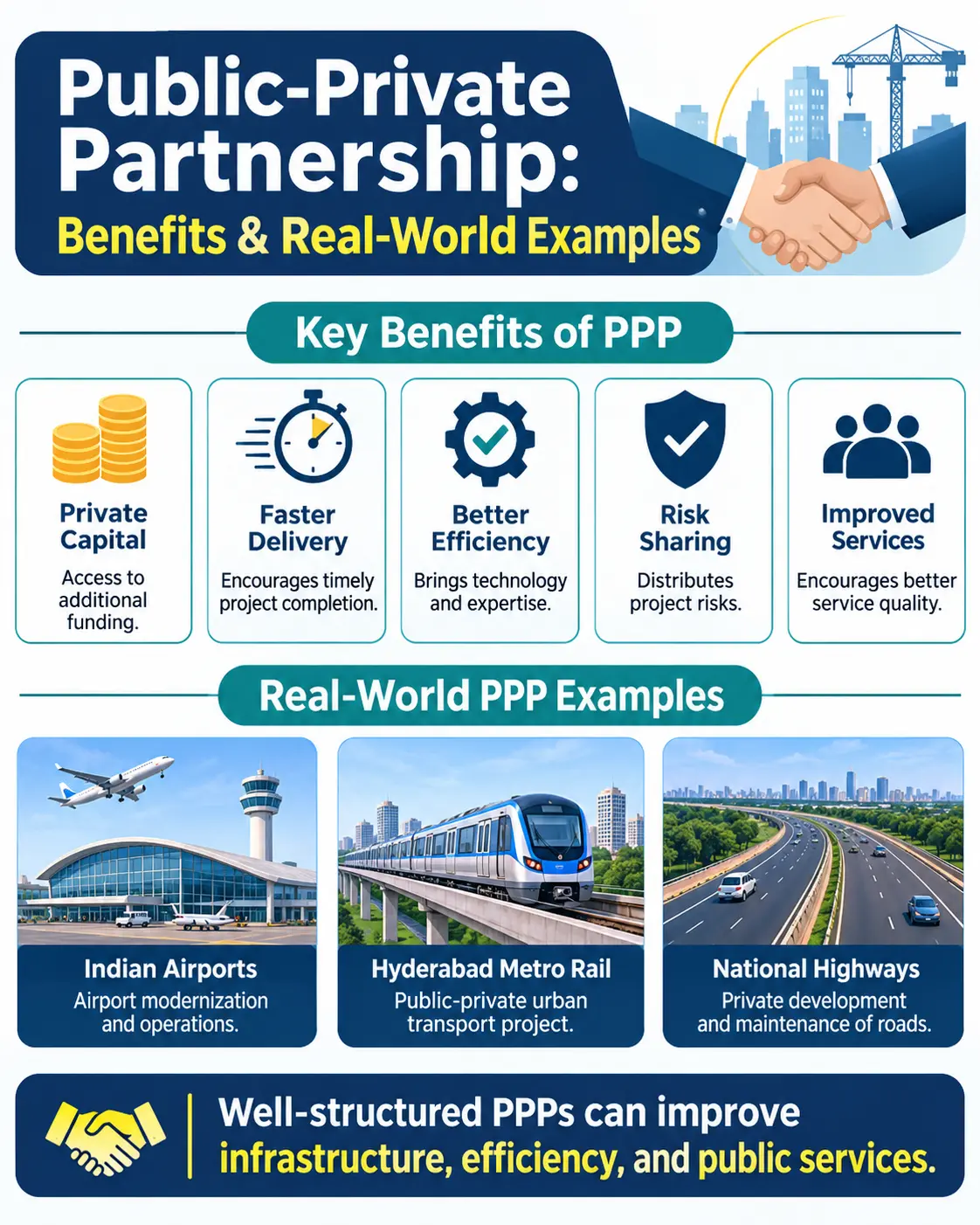
PPPs offer several benefits, including access to private capital, faster project delivery, better efficiency, innovation, risk sharing, and improved service quality.
Poorly structured PPP projects can face challenges such as complex contracts, higher financing costs, unclear risk allocation, disputes, and limited transparency. Careful planning and strong government oversight help reduce these risks.
Successful public private partnership examples include India's major airports, Hyderabad Metro Rail, national highways, the Chicago Skyway, and the Channel Tunnel.
In this blog, you'll learn the PPP full form, meaning, key features, common models, benefits, risks, and real-world examples of public private partnerships across different sectors.
Every country needs strong infrastructure, from highways and airports to schools and hospitals. Yet building and maintaining these assets costs enormous amounts of money, and public budgets are often limited. Governments also face pressure to deliver projects quickly, efficiently, and to a high standard.
This is where the public private partnership model comes in. By combining public goals with private capitaland expertise, governments can deliver projects that might otherwise be delayed or never built at all. In this blog, you will learn the PPP full form, find out what is public private partnership in simple terms, explore its benefits and risks, and review some well-known public private partnership examples from around the world.
Let us start with the basics. The PPP full form in this context is Public Private Partnership. It refers to a long-term agreement between a government body and a private company to finance, build, operate, or maintain a public asset or service.
It is worth noting that the abbreviation PPP is also used in other fields. In economics, it can mean purchasing power parity, and in the United States, it was widely recognized during the pandemic as the Paycheck Protection Program. In infrastructure, finance, and public policy, however, PPP almost always means public private partnership.
What Is Public Private Partnership? A Simple Explanation
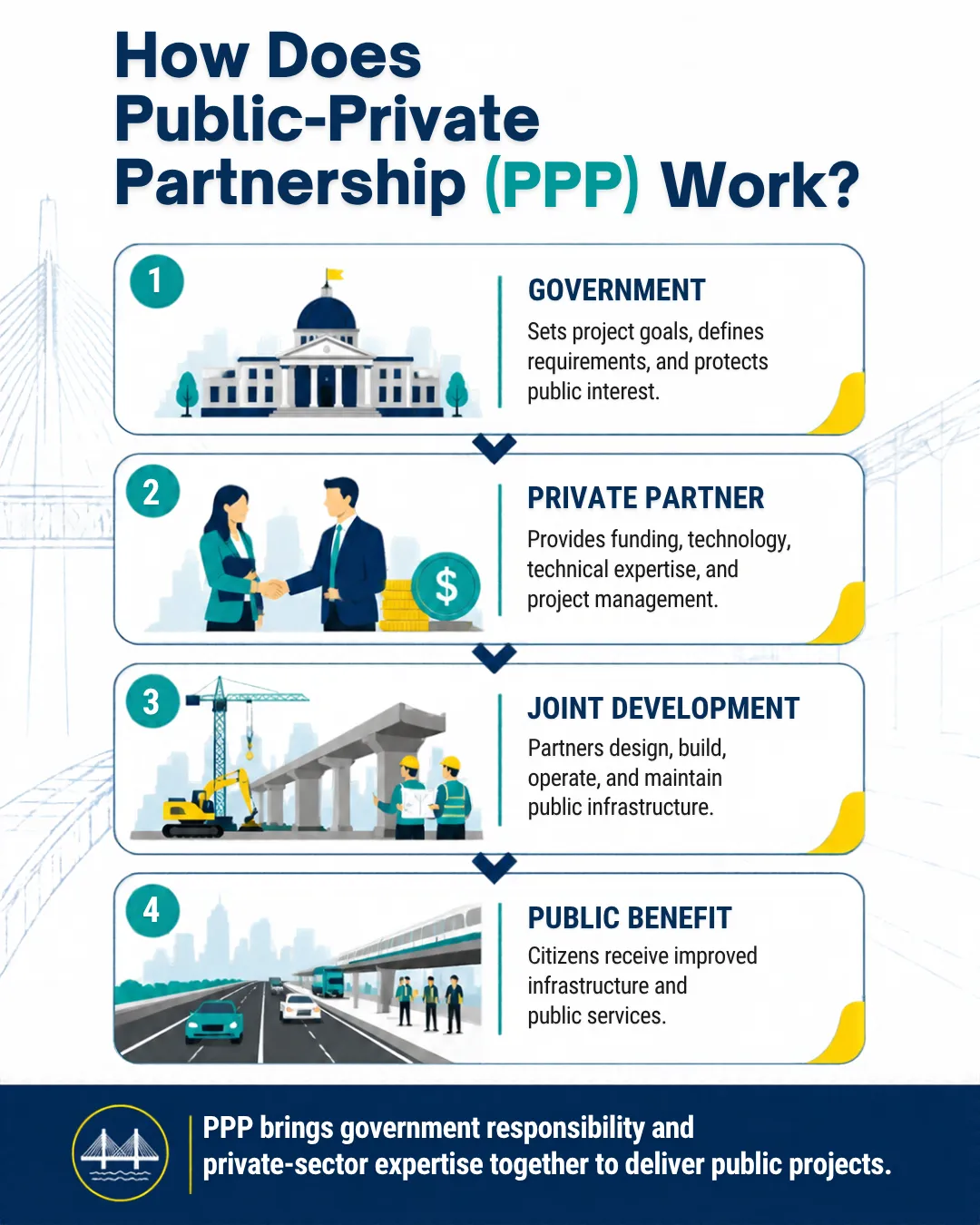
So, what is public private partnership at its core? It is a formal arrangement in which the public sector and the private sector share responsibilities, risks, and rewards to deliver a project or service that serves the public.
The public partner is usually a national, state, or local government agency. It sets the goals, protects the public interest, and often owns the asset. The private partner is a company or a group of companies that brings funding, technical skills, project management, and operational experience.
It helps to think of a public private partnership as a team effort. The government says what the community needs, such as a toll road with safe lanes and fair pricing. The private company designs, builds, and often runs the road for an agreed period. In return, it earns revenue through tolls, fees, or regular payments from the government. When the agreement ends, the asset is usually handed back to the public authority.
A PPP is different from simple privatization. In privatization, ownership and control of a public asset move permanently to a private firm. In a public private partnership, the government remains involved and accountable, and the public interest stays at the center of the contract.
While each agreement is unique, most PPP projects share several common features:
Long-term contracts. Agreements often last 15 to 30 years or more, because infrastructure takes time to build and to earn returns.
Risk sharing. Risks such as construction delays, cost overruns, demand changes, and maintenance are divided between the partners according to who can manage them best.
Performance-based payments. The private partner is paid based on meeting agreed standards, such as service quality, safety, or availability.
Private financing. Part or all of the funding comes from private investors and lenders, reducing the immediate burden on public budgets.
Public accountability. The government retains oversight and ensures the service remains accessible and fair.
Common Types of Public Private Partnership Models
There is no single model. Governments choose the structure that best suits the project. Some of the most common models include:
Build-Operate-Transfer (BOT) – The private partner builds the asset, operates it for a fixed period to recover its investment, and then transfers it to the government.
Build-Own-Operate-Transfer (BOOT) – Similar to BOT, but the private partner owns the asset during the contract term before handing it over.
Design-Build-Finance-Operate (DBFO) – The private partner handles design, construction, financing, andoperation, usually in return for regular payments tied to performance.
Lease and concession models – The government grants a private company the right to operate and maintain an existing asset, such as an airport or toll road, for a set period in exchange for fees or a share of revenue.
Hybrid Annuity Model – Used widely in India for highways, this model splits the cost, with the government paying a portion during construction and the rest as annual payments over time. This reduces the revenue risk for the private partner.
Benefits of Public Private Partnership
Governments and businesses turn to this model for several good reasons.
Access to Private Capital
Public budgets are stretched thin by education, health care, defense, and social programs. A public private partnership allows governments to bring in private funds, so that important projects can move forward sooner.
Faster Project Delivery
Private companies are often motivated by deadlines and profit, which can encourage them to complete projects on time. Contracts typically include penalties for delays, which adds further discipline.
Better Efficiency and Innovation
Private firms bring modern technology, project management skills, and fresh ideas. This can lead to better design, lower lifecycle costs, and more efficient operations.
Risk Transfer
In a traditional government project, taxpayers often bear the cost of overruns and delays. In a well-designed PPP, many of these risks are transferred to the private partner, who is better placed to manage them.
Improved Quality of Service
Because payments are linked to performance, private partners have a strong reason to maintain assets properly and deliver reliable service throughout the contract.
Focus on the Whole Lifecycle
PPP contracts usually cover design, construction, and maintenance together. This encourages builders to use durable materials and thoughtful planning, since they will be responsible for the asset in the long run.
Public Private Partnership Examples From Around the World
Now let us look at some well-known public private partnership examples. These projects show how the model works in different sectors and countries.
Airports in India
The modernization of major airports in Delhi, Mumbai, Hyderabad, and Bengaluru is often cited as a success story of the PPP approach in India. In these cases, the government partnered with private consortiums to develop and operate airports. Passenger traffic, terminal quality, and retail and commercial facilities have improved substantially under this arrangement, and the airport authority continues to receive a share of revenue.
Hyderabad Metro Rail, India
Hyderabad Metro Rail is frequently described as one of the largest PPP-based metro projects in the world. A private company took responsibility for designing, financing, building, and operating the system, with the state government providing support such as land. It shows how large urban transport projects can be delivered through a partnership.
Highways and Expressways
India has used several PPP structures, including BOT and the hybrid annuity model, to expand its national highway network. Under these arrangements, private developers build and maintain roads, and recover their investment through toll revenue or government annuity payments.
The Chicago Skyway, United States
The Chicago Skyway is a toll road that the City of Chicago leased to a private operator in 2005 under a long-term concession. The city received a large upfront payment, while the private partner took on responsibility for operations, maintenance, and toll collection. This example is often discussed in debates about the benefits and risks of leasing existing public assets.
The Channel Tunnel, United Kingdom and France
The Channel Tunnel, which links the United Kingdom and France beneath the English Channel, was built with private financing under a long-term concession from both governments. It is a landmark example of a very large infrastructure project funded largely by private investors, though it also demonstrated the challenges of cost overruns and financial pressure.
Health Care and Vaccines
PPP is not limited to roads and airports. During the COVID-19 pandemic, partnerships between governments, universities, and pharmaceutical companies helped speed up vaccine development and distribution. Global health initiatives such as Gavi, the Vaccine Alliance, also bring together governments, international organizations, and private partners to improve access to immunization.
Water and Sanitation
Many cities around the world have partnered with private firms to improve water supply, wastewater treatment, and desalination. These projects often rely on private expertise to reduce water losses and improve service quality.
Why a Public Private Partnership Matters for the Future
Global infrastructure needs are growing quickly. Cities are expanding, climate goals require clean energy and resilient systems, and digital connectivity has become essential. Governments alone cannot meet all these needs through public funds.
A well-structured public private partnership offers a path forward. It can help countries build renewable energy plants, modern transport networks, smart cities, affordable housing, and health care facilities, while also encouraging innovation and efficiency. At the same time, citizens benefit most when governments remain transparent, protect public interest, and choose projects that make sense for the community.
A public private partnership brings together the strengths of two worlds: the public sector’s responsibility to serve citizens and the private sector’s capital, speed, and expertise. Now that you know the PPP full form, understand what is public private partnership, and have seen real public private partnership examples, you can better judge how this model works in practice.
The approach is not a magic solution. It requires careful planning, balanced contracts, and strong oversight. But when done right, it can deliver high-quality infrastructure and services that improve lives, support economic growth, and make better use of limited public resources.
Frequently Asked Questions
In infrastructure and public policy, the PPP full form is Public Private Partnership. It describes a long-term collaboration in which a government agency and a private company share the financing, building, operation, or maintenance of a public asset or service.
In privatization, ownership and control of an asset move permanently to a private company. In a public private partnership, the government typically keeps ownership or oversight, and the private partner works under a defined contract for a fixed period. The public interest remains protected throughout.
Well-known examples include the modernized airports in Delhi, Mumbai, Hyderabad, and Bengaluru, the Hyderabad Metro Rail, the Chicago Skyway toll road lease, and the Channel Tunnel between the United Kingdom and France. PPPs are also used in health care, water supply, and renewable energy.
The main risks include complex contracts, higher financing costs, unclear risk allocation, possible disputes, and limited transparency. If a project is poorly designed, the government may end up bearing costs, or users may face high fees. Strong regulation and careful planning help reduce these risks.
Nuthana Reddy
Nuthana Reddy is a Senior Manager at Procter & Gamble, specializing in operations, digitization, and cross-functional leadership. She has driven multimillion-dollar impact through innovation, process optimization, and strategic execution across global markets.
Get Free Upskilling Guidance
Fill in the details for a free consultation
Related Courses
Explore our programs
Executive Certificate Programme in Corporate & Strategic Finance

 November 20, 2026
 7 min read





 Key Insights
 ChatGPT
 Perplexity
 Claude
 Grok










 ROI Calculator