
Which MBA specialization to choose: Marketing vs. Finance
 April 14, 2025
 10 min read





Table Of Content
- Marketing vs. Finance: Understanding the Core Difference
- Career Opportunities After MBA in Marketing
- Career Opportunities After MBA in Finance
- Marketing vs. Finance: Skill Gap and Market Demand
You may be at a crossroads right now. Perhaps you are a working professional aiming to move into leadership roles, or a recent graduate trying to decide which of the many MBA specializations can truly future-proof your career. With industries transforming rapidly due to digitalisation, data-driven decision-making, and global competition, choosing the right MBA path has never been more important, or more confusing.
Among the most popular MBA specializations, Marketing and Finance consistently stand out. In the Indian job market, professionals with an MBA in Marketing typically earn between ₹6–20 LPA, while those with an MBA in Finance often see salary ranges of ₹8–25 LPA, depending on industry, experience, and role. Professionals today often ask: Which path aligns better with my strengths, career goals, and the evolving job market?
This blog explores marketing vs finance in depth, helping you understand career roles, skills required, salary brackets, and long-term opportunities. Whether you are seeking career acceleration, a domain switch, or structured upskilling, understanding these MBA specializations can help you make a more informed decision, one that balances ambition with practicality.
 ChatGPT
 Perplexity
 Claude
 Grok
GrokMarketing vs. Finance: Understanding the Core Difference
Before comparing outcomes, it is essential to understand what fundamentally differentiates these two MBA specializations.
| Aspect | MBA in Marketing | MBA in Finance |
| Core Focus | Customer behaviour, branding, growth strategy | Financial analysis, capital management |
| Decision Style | Creative + analytical | Highly analytical and quantitative |
| Industry Reach | FMCG, IT, e-commerce, media, startups | Banking, consulting, corporate finance, fintech |
| Ideal for | Professionals who enjoy people, strategy, and storytelling | Professionals who prefer numbers, structure, and financial strategy |
Both options remain among the most sought-after MBA specializations, but suitability depends largely on individual aptitude and long-term career vision.
Career Opportunities After MBA in Marketing

*jaroeducation.com
An MBA in Marketing opens doors to a wide spectrum of roles that focus on understanding customer needs, creating value propositions, and driving business growth. Among all MBA specializations, Marketing is considered one of the most versatile because its applications cut across industries such as FMCG, IT, e-commerce, healthcare, media, education, and startups. As organisations become increasingly customer-centric and digital-first, professionals with strong marketing acumen are in sustained demand.
This specialization equips learners with a blend of strategic thinking, analytical ability, communication skills, and market awareness, making it suitable for both creative and data-driven professionals.
1. Core Job Roles After MBA in Marketing
Graduates with an MBA in Marketing can pursue diverse roles depending on their interests, industry preference, and experience level.
Marketing Manager
Marketing Managers are responsible for planning and executing marketing strategies to promote products or services. Their role includes campaign planning, budget allocation, coordination with sales teams, and performance tracking. This position often acts as a stepping stone to senior leadership roles.
Brand Manager
Brand Managers focus on building, positioning, and maintaining a brand’s identity in the market. They work closely with advertising agencies, product teams, and market research units to ensure consistent messaging and long-term brand equity.
Product Marketing Manager
This role bridges product development and marketing. Product Marketing Managers define go-to-market strategies, communicate product value to customers, and enable sales teams with positioning and messaging.
Digital Marketing Manager
With the rise of digital channels, this role has become one of the most sought-after. Professionals manage online campaigns across search engines, social media, email, and content platforms, while analysing data to optimise performance.
Sales and Business Development Manager
These professionals focus on revenue generation by identifying new markets, building client relationships, negotiating deals, and aligning sales strategies with overall business goals.
Growth Manager
Growth Managers work in fast-paced environments such as startups and tech firms, where they experiment with acquisition, retention, and monetisation strategies to accelerate business growth.
2. Key Skills Developed Through an MBA in Marketing
One of the reasons Marketing remains among the most popular MBA specializations is the broad skill set it develops.
- Consumer Behaviour & Market Research: Understanding customer needs, preferences, and buying patterns
- Brand Strategy & Communication: Crafting compelling narratives and positioning strategies
- Digital & Performance Marketing: SEO, social media marketing, paid campaigns, and analytics
- Sales Strategy & Negotiation: Building pipelines, closing deals, and managing key accounts
- Data Interpretation & Insights: Using market data and dashboards to drive decisions
These skills are transferable across roles and industries, offering long-term career flexibility.
3. Industry-Wise Career Scope and Salary Ranges (India – Approx.)
Marketing professionals are required across nearly every sector. Salary ranges vary by industry, company size, and individual experience.
| Industry | Typical Roles | Average Annual Salary |
| FMCG | Brand Manager, Marketing Manager | ₹8–15 LPA |
| E-commerce & Startups | Growth Manager, Performance Marketer | ₹10–20 LPA |
| IT & SaaS | Product Marketing, Demand Generation | ₹9–18 LPA |
| Media & Advertising | Account Director, Campaign Manager | ₹6–12 LPA |
| Healthcare & Education | Marketing Strategy, Outreach Lead | ₹7–14 LPA |
Salary ranges are indicative and based on aggregated data from industry reports, job portals, and market surveys.
4. Advantages of Choosing Marketing as an MBA Specialization
- High Cross-Industry Demand: Every organisation needs marketing expertise to grow and compete
- Leadership Visibility: Marketing roles often work closely with senior management
- Creative and Strategic Balance: Ideal for professionals who enjoy both ideation and analysis
- Global Relevance: Marketing skills are transferable across geographies
These factors make Marketing one of the best MBA specializations for professionals seeking dynamic and people-oriented careers.
5. Challenges and Considerations
While Marketing offers exciting opportunities, it also comes with certain challenges that professionals should be prepared for.
- Performance Pressure: Many roles are linked to targets and measurable outcomes
- Rapid Skill Evolution: Continuous learning is required due to changing tools and platforms
- Market Sensitivity: Results can be influenced by economic conditions and consumer sentiment
Understanding these realities helps set realistic expectations and long-term career plans.
6. Long-Term Career Growth in Marketing
With experience, professionals can move into senior leadership roles such as Head of Marketing, Chief Marketing Officer (CMO), or General Manager. Some also transition into consulting, entrepreneurship, or cross-functional leadership roles.
Among all MBA specializations, Marketing offers one of the broadest growth trajectories, especially for professionals willing to adapt, learn continuously, and align strategies with evolving customer expectations.





Career Opportunities After MBA in Finance
An MBA in Finance equips professionals with advanced knowledge of financial management, investment strategy, risk assessment, and capital optimisation. Among all MBA specializations, Finance is regarded as one of the most structured and analytically rigorous domains, playing a critical role in strategic decision-making across organisations.
From traditional banking and financial services to fast-growing sectors such as fintech, consulting, and corporate strategy, finance professionals are essential for ensuring organisational stability, profitability, and compliance. This specialization is particularly suitable for individuals who are comfortable working with numbers, frameworks, and data-driven insights.
1. Core Job Roles After MBA in Finance
An MBA in Finance opens pathways to a wide range of roles that influence financial planning, investments, and risk management at both operational and strategic levels.
Financial Analyst
Financial Analysts evaluate financial data, prepare reports, forecast performance, and support leadership in making informed investment and budgeting decisions. This role forms the foundation for many advanced finance careers.
Investment Banker
Investment Bankers advise corporations and governments on mergers, acquisitions, capital raising, and restructuring. The role demands strong analytical skills, financial modelling expertise, and the ability to work in high-pressure environments.
Corporate Finance Manager
Professionals in this role manage capital allocation, funding strategies, and long-term financial planning within an organisation. They work closely with senior management to align financial goals with business objectives.
Risk and Compliance Manager
Risk Managers identify, assess, and mitigate financial and operational risks. Compliance Managers ensure that organisations adhere to regulatory and legal standards, a function that has gained importance with increasing global regulations.
Equity Research Analyst
Equity Research Analysts study market trends, company financials, and industry dynamics to provide investment recommendations. This role is prominent in brokerage firms, asset management companies, and investment funds.
Finance Controller
Finance Controllers oversee accounting operations, financial reporting, budgeting, and internal controls. This role is crucial for maintaining financial discipline and transparency within organisations.
2. Key Skills Developed Through an MBA in Finance
Finance remains one of the most demanding MBA specializations due to the depth of expertise it builds across quantitative and strategic domains.
- Financial Modelling and Valuation: Assessing company worth and investment viability
- Accounting and Regulatory Knowledge: Understanding financial statements and compliance norms
- Risk Management: Identifying and mitigating financial and operational risks
- Capital Markets and Investments: Equity, debt, derivatives, and portfolio management
- Strategic Financial Planning: Long-term budgeting and resource allocation
These skills are highly transferable and valued across industries and geographies.
3. Industry-Wise Career Scope and Salary Ranges (India – Approx.)
Finance professionals are required across sectors, from traditional financial institutions to emerging technology-driven enterprises.
| Industry | Typical Roles | Average Annual Salary |
| Banking & Financial Services | Financial Analyst, Risk Manager | ₹9–18 LPA |
| Consulting | Finance Consultant, Strategy Analyst | ₹10–22 LPA |
| Fintech | Business Finance Lead, Investment Analyst | ₹12–25 LPA |
| Corporate Sector | Corporate Finance Manager, Controller | ₹8–16 LPA |
| Asset Management & PE | Equity Research, Fund Analyst | ₹10–24 LPA |
Salary figures are indicative and based on aggregated insights from industry reports, job portals, and market studies.
4. Advantages of Choosing Finance as an MBA Specialization
- Strong Long-Term Demand: Finance is integral to every organisation’s operations and growth
- High Strategic Influence: Finance professionals contribute directly to leadership decisions
- Global Career Mobility: Financial expertise is transferable across countries and markets
- Clear Career Progression: Structured pathways from analyst to senior leadership roles
These benefits position Finance as one of the best MBA specializations for professionals seeking stability and influence.
5. Challenges and Considerations
Despite its advantages, Finance presents challenges that professionals should evaluate carefully.
- Steep Learning Curve: Requires strong quantitative aptitude and continuous learning.
- High Accountability: Errors can have significant financial and regulatory implications.
- Demanding Work Environments: Certain roles involve long hours and high pressure.
Understanding these factors helps professionals make informed decisions and prepare effectively.
6. Long-Term Career Growth in Finance
With experience and domain expertise, professionals can progress into senior roles such as Chief Financial Officer (CFO), Finance Director, or Managing Partner. Some also transition into consulting, entrepreneurship, or advisory roles.
Among all MBA specializations, Finance offers one of the most structured and globally recognised career trajectories, particularly for professionals who value analytical depth, strategic impact, and long-term growth.
Marketing vs. Finance: Skill Gap and Market Demand
*jaroeducation.com
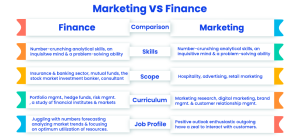
One of the key considerations when choosing between these MBA specializations is how well your existing skills align with market demand.
Skill Gap Comparison
| Factor | Marketing | Finance |
| Technology Impact | High (digital tools, AI, analytics) | Moderate to high (fintech, automation) |
| Entry Barrier | Moderate | High |
| Cross-functional Mobility | High | Moderate |
| Global Demand | Strong | Very strong |
Both fields are evolving, but Marketing is seeing rapid transformation due to digital platforms, while Finance is being reshaped by fintech and regulatory changes. Selecting the best MBA specialization depends on how willing you are to continuously reskill.
Which MBA Specialization Is Right for You?
Choosing between Marketing and Finance is not about which is better universally, it is about which is better for you. Among all MBA specializations, clarity of personal goals is critical.
Consider Marketing if:
- You enjoy storytelling, persuasion, and strategy
- You prefer customer-facing or growth-oriented roles
- You are comfortable with ambiguity and experimentation
Consider Finance if:
- You excel in numbers and structured analysis
- You aim for roles in banking, consulting, or corporate leadership
- You value predictability and long-term stability
Both options rank highly among MBA specializations that offer leadership potential and cross-industry relevance.
How Jaro Education Supports Your MBA Journey
Choosing from multiple MBA specializations can feel overwhelming. This is where structured guidance and the right academic partnerships matter.
Jaro Education is a leading online higher education and upskilling platform that collaborates with reputed universities and institutions. It enables learners to access industry-relevant programs designed for working professionals and aspiring leaders.
Program Highlights
Executive Certificate Programme in Advanced Marketing Analytics & Management
For professionals inclined towards Marketing-focused MBA specializations and data-driven growth roles, this certification program offers targeted upskilling aligned with current industry needs.
- Learning Format: Live Online
- Duration: 6 Months
- Curriculum Focus: Marketing analytics frameworks and decision-making models. Data-driven customer segmentation and targeting
- Ideal For: Working professionals, career switchers, aspiring managers
What Jaro Offers
- Personalised career counselling to identify the best MBA specialization
- Access to curated programs based on market insights
- Academic support and learner engagement
- Value-added services through Jaro Connect, including industry webinars and networking
For degree programs, Jaro provides career guidance and learner support; it is not the degree-granting body. For certification programs, Jaro acts as an exclusive service partner in collaboration with institutions like IITs and IIMs.
A subtle first step can be registering for counselling to understand which of the many MBA specializations aligns best with your goals.
Conclusion
Deciding between Marketing and Finance is one of the most important choices in your MBA journey. Both remain top MBA specializations because they offer strong career relevance, leadership pathways, and long-term growth. The real differentiator lies in self-awareness; understanding your strengths, interests, and the kind of professional life you want to build.
As industries continue to evolve, the right combination of education, upskilling, and mentorship becomes critical. With expert guidance, curated programs, and learner-centric support, Jaro Education helps you navigate the complex landscape of MBA specializations with clarity and confidence.
Your next career move does not have to be a leap of faith, it can be a well-informed step forward.
Frequently Asked Questions
Jaro Education acts as an online higher education and upskilling platform that collaborates with reputed universities and institutions. While the academic institution awards the degree, Jaro provides end-to-end learner support, including programme guidance, academic coordination, and access to value-added services throughout the learning journey.
Yes, Jaro Education offers personalised counselling to help learners choose from various MBA specializations based on their career goals, experience, and market trends. Learners also benefit from additional support such as industry interactions, webinars, and networking opportunities through Jaro Connect.

Related Courses
Explore our programs
 Admission Open
 Admission Open
 Admission Open
 Admission Open
Find a Program made just for YOU
We'll help you find the right fit for your solution. Let's get you connected with the perfect solution.
Is Your Upskilling Effort worth it?
 ROI Calculator

Are Your Skills Meeting Job Demands?
Try our Skill Gap tool
Experience Lifelong Learning and Connect with Like-minded Professionals
Explore Jaro Connect

