
John Nash’s Game Theory: How to Predict Your Rival’s Move
 November 14, 2026
 10 min read





Table Of Content
- Who Was John Nash?
- What Is Game Theory?
- Game Theory in Economics
- John Nash Game Theory: The Nash Equilibrium
 Key Insights
- John Nash’s game theory explains how individuals and businesses make strategic decisions based on the choices and actions of others.
- The Nash equilibrium helps predict stable outcomes where no player can improve their result by changing their strategy alone.
- Game theory in economics is used to understand pricing competition, auctions, negotiations, public goods, and government regulations.
- The Prisoner’s Dilemma and pricing decisions between rival firms show how individual choices can lead to outcomes that are not beneficial for everyone.
- In this blog, you'll learn about John Nash’s contributions, the Nash equilibrium, game theory formulas, practical examples, strategies to predict rival moves, and the limitations of game theory.
Every day, businesses and individuals make decisions that depend on what other people will do. A retailer sets a price while watching a competitor. A bidder makes an offer without knowing the other bids. A manager negotiates a deal where both sides want the best outcome. In each case, success depends on thinking one step ahead. This is exactly the skill that game theory teaches, and few people shaped it more than the mathematician John Nash. Professionals who want to turn this kind of strategic thinking into a career advantage can explore structured learning options such as the Executive Management Programme in Advanced Strategic Management by CEP, IIT Delhi, which builds strategic decision-making skills for working managers. In this blog, we explain John Nash's ideas in simple, formal language, with clear examples you can apply right away.
 ChatGPT
 Perplexity
 Claude
 Grok
Who Was John Nash?
John Forbes Nash Jr. (1928–2015) was an American mathematician who made groundbreaking contributions to game theory, differential geometry, and the study of partial differential equations. He completed his PhD at Princeton University in 1950 with a short but powerful thesis on non-cooperative games. A year later, his work on the subject appeared in the Annals of Mathematics, and the field of strategic decision-making was never the same again.
In 1994, John Nash shared the Nobel Memorial Prize in Economic Sciences with John Harsanyi and Reinhard Selten for their analysis of equilibria in non-cooperative games. Decades later, in 2015, he received the Abel Prize for his work on nonlinear partial differential equations. His life, including his long struggle with mental illness, became widely known through the book and film A Beautiful Mind.
What makes Nash’s story remarkable is that a single idea, formulated when he was in his early twenties, continues to guide economists, business leaders, political scientists, and even biologists today.
What Is Game Theory?
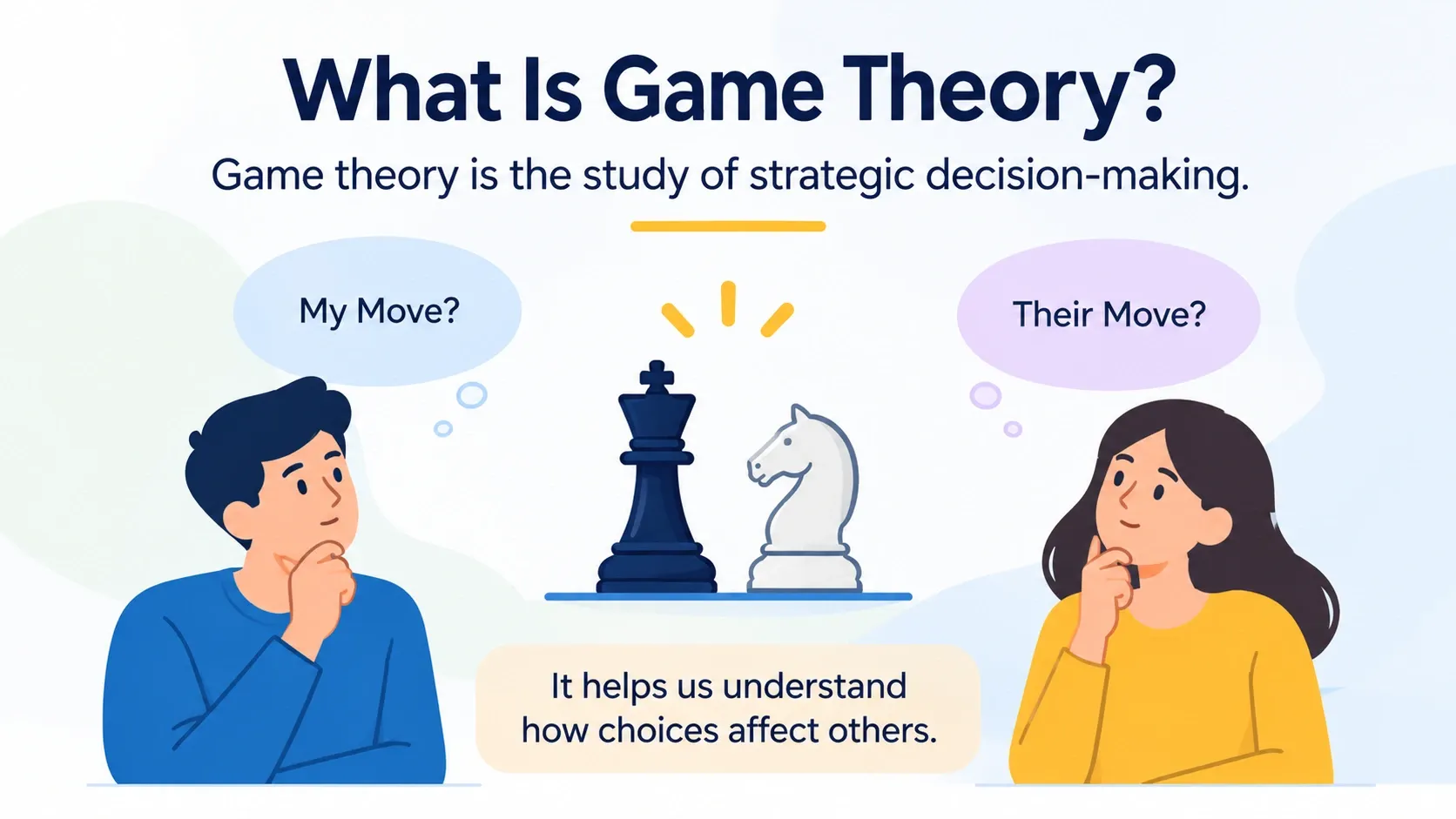
Game theory is the study of strategic decision-making. It examines situations where the outcome for each person depends not only on their own choices but also on the choices of others. The word “game” is often seen as unimportant. Rather, it simply refers to any situation with rules, choices, and consequences.
Every game has three basic parts:
- Players: The decision-makers, such as companies, governments, or individuals.
- Strategies: The actions each player can choose.
- Payoffs: The rewards or losses each player receives, depending on the combination of choices.
The modern field began in 1944, when mathematician John von Neumann and economist Oskar Morgenstern published Theory of Games and Economic Behavior. Their work focused mainly on two-player, zero-sum games, where one player’s gain is exactly the other’s loss. Nash widened the scope dramatically by showing how to analyze games where players can both compete and benefit, which describes most real-life situations.
Game Theory in Economics
Game theory in economics gives us a clear way to understand markets where a few players influence each other. In a perfectly competitive market, thousands of small sellers simply accept the market price. But in an oligopoly, where a handful of firms dominate, every pricing, advertising, or production decision triggers a response from rivals. Traditional supply and demand analysis cannot fully explain this behavior, while game theory can.
Economists use it to study:
- Pricing and competition: Why airlines, telecom companies, and ride-hailing platforms often match each other’s price moves.
- Auctions: How bidders should bid when they do not know what others will offer. Spectrum auctions and online advertising auctions are built on game-theoretic design.
- Bargaining and negotiation: How two sides divide a surplus, such as in wage talks or trade agreements.
- Public goods and the environment: Why countries struggle to cut emissions when each hopes others will do the work.
- Regulation and policy: How firms respond when a government changes taxes, quotas, or rules.
Beyond economics, the same tools help in politics, military strategy, computer science, and evolutionary biology. That wide reach is why game theory has become a core part of modern management thinking.
John Nash Game Theory: The Nash Equilibrium
The heart of John Nash game theory is a concept now known as the Nash equilibrium. It describes a situation in which each player has chosen the best strategy for themselves, given what every other player is doing. At that point, no one can improve their result by changing their own strategy alone.
Here is a simple way to picture it. Imagine two shops on the same street deciding whether to run a discount. If both shops are happy with their choice after seeing what the other has done, and neither would gain by switching, they are in a Nash equilibrium. It does not mean the outcome is the best possible for both. It only means no one has a reason to move first.
This idea was powerful for a few reasons:
- It applies to many players, not just two.
- It works for games where cooperation is not guaranteed.
- It gives a clear, testable way to predict stable outcomes.
Nash also proved that every finite game has at least one equilibrium, provided players are allowed to use “mixed strategies,” which means choosing actions with certain probabilities. This result gave economists confidence that equilibrium analysis would always have an answer.
Game Theory Formula: How Equilibrium Is Defined
Game theory does not have one single formula, as a physics law might. Instead, it offers a few core mathematical statements. The most important game theory formula is the condition for a Nash equilibrium.
Suppose there are n players. Each player i chooses a strategy s_i, and u_i is the payoff for player i. A set of strategies (s_1*, s_2*, …, s_n*) is a Nash equilibrium if, for every player i:

In plain words: given what everyone else is doing (s_{-i}), player i cannot get a higher payoff by switching from their equilibrium strategy (s_i) to any other strategy (s_i).
Expected Payoff for Mixed Strategies
When players randomize, we use expected payoff. If a player chooses action A with probability p and action B with probability (1 − p), the expected payoff is:

In a mixed-strategy equilibrium, a player chooses probabilities that make the other player indifferent between their options. This is a neat idea: to keep a rival from exploiting you, you must be unpredictable in exactly the right way. A soccer goalkeeper who always dives left, or a penalty taker who always shoots right, can be beaten easily. Mixing the choices removes the pattern.
Game Theory Example 1: The Prisoner's Dilemma
The most famous game theory example is the Prisoner’s Dilemma. Two suspects are arrested and held in separate rooms. Each can stay silent or confess. The payoffs, measured in years in prison (shown as negative numbers), are below.
| Prisoner’s Dilemma | Prisoner B stays silent | Prisoner B confesses |
| Prisoner A stays silent | A: −1, B: −1 | A: −3, B: 0 |
| Prisoner A confesses | A: 0, B: −3 | A: −2, B: −2 |
Look at it from Prisoner A’s side. If B stays silent, A does better by confessing (0 instead of −1). If B confesses, A again does better by confessing (−2 instead of −3). So confessing is the best reply no matter what B does. The same logic applies to B. The Nash equilibrium is therefore (confess, confess), with both getting −2.
The twist is that both would be better off if they had stayed silent (−1 each). The equilibrium is not the best joint outcome. This tension between individual rationality and group benefit appears everywhere, from price wars to arms races to climate agreements.





Game Theory Example 2: A Pricing Decision Between Two Firms
Here is a business version. Two rival coffee chains, Firm A and Firm B, must each choose a high price or a low price. The numbers below show monthly profits in millions of dollars.
| Price Competition | Firm B: High price | Firm B: Low price |
| Firm A: High price | A: 10, B: 10 | A: 4, B: 14 |
| Firm A: Low price | A: 14, B: 4 | A: 6, B: 6 |
If Firm B keeps prices high, Firm A earns more by cutting its price (14 versus 10). If Firm B cuts its price, Firm A still earns more by cutting (6 versus 4). So low pricing is the best reply in every case, and the same is true for Firm B. The Nash equilibrium is (low, low), with each firm earning 6 million, even though both would earn 10 million if they held prices high.
This explains why price wars are so common and so hard to stop. It also shows why firms try to escape the trap through brand loyalty, long-term contracts, or product differences that make price cuts less tempting. In repeated games, where rivals interact month after month, the threat of future retaliation can help firms sustain higher prices without a formal agreement.
How to Predict Your Rival's Move Using Game Theory
You do not need advanced mathematics to use these ideas. A simple five-step process can help in negotiations, pricing, hiring, and competitive planning.
- Identify the players. Who else’s decisions affect your result? List customers, competitors, suppliers, and regulators.
- List each player’s options. Write down what you can do and what your rival can do. Include doing nothing.
- Estimate the payoffs. For each combination of choices, consider profit, market share, reputation, or risk. Be realistic about what your rival values, not just what you value.
- Look for dominant strategies. If one option is better for a player no matter what the other does, expect that player to choose it. You can then remove the weaker options.
- Find the stable outcome. Check which pair of choices leaves neither side wanting to switch. That is your likely equilibrium and your best prediction of the rival’s move.
A good habit is to ask: “If I were my rival, with their goals and constraints, what would I do?” This simple shift in viewpoint is the practical core of strategic thinking.
Limits of Nash Equilibrium
Like any model, Nash’s framework has limits, and it is wise to know them.
- Rationality is assumed. The model expects players to think clearly about payoffs. Real people are influenced by emotion, habit, and limited information.
- Multiple equilibria. Some games have several equilibria, and theory alone cannot say which will occur.
- Payoffs are hard to measure. In real business situations, estimating exact payoffs is difficult.
- Not always efficient. As the Prisoner’s Dilemma shows, an equilibrium can leave everyone worse off than another outcome.
Behavioral economics and evolutionary game theory have added many improvements, but Nash’s idea remains the starting point for nearly all strategic analysis.
Why Strategic Thinking Matters for Professionals
Understanding John Nash and game theory is more than an academic exercise. Managers face strategic games every week: when to launch a product, how to respond to a competitor’s campaign, how to structure a partnership, or how to negotiate a contract. Leaders who can read incentives and anticipate rival moves make clearer, more confident decisions.
This is where structured learning can help. The Executive Management Programme in Advanced Strategic Management by CEP, IIT Delhi, offered through Jaro Education, is designed for working professionals who want to sharpen exactly these skills. Here is what the programme offers:
- Duration and format: 10 months, with live sessions on Saturday evenings from 6:00 PM to 9:00 PM, so you can learn alongside your job.
- Curriculum: 13 modules covering strategic intent and performance, strategic innovation, strategic decision-making in a data-driven world, strategic leadership and change management, global business strategy, and artificial intelligence in business strategy.
- Learning approach: About 120 hours of learning that includes guest lectures and projects.
- Eligibility: A graduation degree in any discipline from a recognized university with at least four years of work experience.
- Credential: A Certificate of Completion from CEP, IIT Delhi, for participants who meet the marks and attendance requirements.
Conclusion
John Nash showed the world that strategy can be studied with logic and mathematics. His equilibrium idea explains why rivals behave the way they do, why price wars begin, and why cooperation is hard even when it benefits everyone. By learning the basics of game theory, from the definition of a Nash equilibrium to simple examples like the Prisoner’s Dilemma, you gain a practical framework for predicting rival moves and planning your own. Whether you apply it in pricing, negotiation, or long-term planning, strategic thinking is a skill that grows stronger with practice, and a structured programme can speed up that growth.
Frequently Asked Questions
John Nash’s contribution is the idea of Nash equilibrium. It describes a situation where every player has picked the best strategy given the choices of others, so no one gains by changing their own strategy alone. It helps predict stable outcomes in competitive situations.
A set of strategies is a Nash equilibrium if, for every player, the payoff from their chosen strategy is at least as high as the payoff from any other strategy, assuming the other players keep their strategies fixed. Written mathematically, u_i(s_i*, s_{-i}) ≥ u_i(s_i, s_{-i}) for all strategies s_i.
Game theory in economics is used to study pricing in oligopolies, auction design, bargaining, regulation, and public goods. Businesses use it to predict competitor responses, set prices, design contracts, and plan negotiations.
It can offer a well-reasoned prediction, especially when you understand your rival’s goals and options. It is not a crystal ball, because real people may not act perfectly rationally and payoffs can be hard to measure. Still, it gives a disciplined way to think through likely responses and prepare for them.






Find a Program made just for YOU
We'll help you find the right fit for your solution. Let's get you connected with the perfect solution.

Is Your Upskilling Effort worth it?
 ROI Calculator


Are Your Skills Meeting Job Demands?
Try our Skill Gap tool
Experience Lifelong Learning and Connect with Like-minded Professionals
Explore Jaro Connect
