A few years ago, sustainability was often viewed as a corporate responsibility initiative led by a small team within an organization. Today, sustainability has become a boardroom priority influencing business strategy, investment decisions, risk management, supply chain operations, and long-term corporate growth.
Across industries, companies are facing increasing pressure from regulators, investors, customers, and stakeholders to demonstrate environmental responsibility and sustainable business practices. Climate risks, carbon emissions, resource efficiency, ESG disclosures, and responsible governance have become important business considerations rather than optional commitments.
In India, the introduction of Business Responsibility and Sustainability Reporting (BRSR) requirements by the Securities and Exchange Board of India (SEBI) has accelerated this transformation. Organizations are increasingly expected to measure, disclose, and improve their sustainability performance, creating a growing demand for professionals who understand ESG frameworks, carbon accounting, climate strategy, and sustainable business leadership.
As a result, sustainability leadership is emerging as one of the most valuable interdisciplinary skill sets for business professionals. The Professional Certificate Programme in Sustainability Leadership by IIT Bombay aims to help professionals understand these evolving business realities while developing practical knowledge of sustainability, ESG reporting, climate action, and strategic decision-making.
Why Sustainability Leadership Is Becoming a Business Priority
Business leaders today operate in a world where environmental and social considerations have direct implications for organizational performance. Investors increasingly evaluate companies based on ESG performance, customers prefer brands demonstrating responsible practices, and governments are implementing stricter sustainability regulations.
Sustainability is no longer limited to environmental conservation. It now influences areas such as corporate governance, supply chain resilience, resource management, risk mitigation, stakeholder trust, and long-term value creation.
Organizations that successfully integrate sustainability into their business strategies often gain advantages in areas such as reputation management, operational efficiency, investor confidence, and regulatory compliance. Conversely, companies that fail to adapt may face financial, operational, and reputational risks.
This shift explains why sustainability leadership is increasingly becoming a strategic capability rather than a specialized function.
How ESG Regulations Are Reshaping Corporate India
One of the biggest drivers of sustainability adoption in India is the evolving regulatory landscape.
The introduction of SEBI’s Business Responsibility and Sustainability Reporting (BRSR) framework has significantly increased the importance of ESG reporting and disclosure among listed companies. Businesses are now expected to provide greater transparency regarding environmental, social, and governance practices.
As organizations work toward compliance and improved sustainability performance, professionals across departments—including finance, operations, human resources, strategy, risk management, and leadership—are expected to understand ESG concepts and their business implications.
This growing emphasis on sustainability reporting is creating demand for professionals who can bridge business strategy with sustainability objectives.
Beyond regulatory requirements, global investors are increasingly evaluating companies based on ESG metrics. Access to capital, investor confidence, and corporate reputation are becoming closely linked to sustainability performance.
As a result, ESG literacy is rapidly becoming a valuable competency for business leaders and working professionals.
Sustainability leadership refers to the ability to integrate environmental, social, and governance considerations into business strategy and decision-making.
Unlike traditional sustainability roles that may focus solely on compliance or environmental initiatives, sustainability leaders help organizations create long-term value while balancing economic, environmental, and social priorities.
These professionals often work across functions to align sustainability goals with broader business objectives.
Their responsibilities may include:
Supporting ESG initiatives
Driving sustainability reporting
Developing climate action strategies
Managing sustainability risks
Improving stakeholder engagement
Promoting responsible business practices
As sustainability becomes embedded within corporate strategy, leaders who understand both business fundamentals and sustainability principles are becoming increasingly valuable.
To understand the relevance of sustainability leadership, it is important to examine three concepts that are shaping modern business practices.
ESG (Environmental, Social, and Governance)
ESG provides a framework for evaluating how organizations manage environmental impact, social responsibilities, and governance practices.
Environmental factors may include carbon emissions, energy consumption, and resource management. Social considerations focus on employees, communities, diversity, and stakeholder relationships. Governance examines areas such as ethics, transparency, accountability, and corporate oversight.
Recognizing the growing importance of sustainability across industries, IIT Bombay has introduced the Professional Certificate Programme in Sustainability Leadership to help professionals understand ESG principles, climate strategy, sustainability reporting, and responsible business practices.
The programme is designed for professionals who want to develop practical knowledge of sustainability frameworks while understanding how sustainability influences organizational performance and decision-making.
Rather than treating sustainability as a standalone subject, the programme explores how environmental, social, governance, and climate-related considerations intersect with modern business strategy.
Why This Programme Is Relevant in 2026
The demand for sustainability expertise is growing across industries because organizations are increasingly expected to demonstrate accountability, transparency, and long-term resilience.
Professionals today are expected to understand:
ESG frameworks and reporting standards
Sustainability strategy
Climate-related business risks
Carbon accounting principles
Stakeholder expectations
Responsible business practices
The IIT Bombay programme addresses these requirements through a structured learning experience that combines academic insights with real-world business applications.
Key Skills Professionals Need in Sustainability Leadership
Sustainability leadership requires more than environmental awareness. Modern professionals need the ability to connect sustainability initiatives with business outcomes and strategic decision-making.
One important capability is understanding ESG frameworks and reporting standards. Professionals increasingly need to interpret sustainability disclosures, evaluate ESG performance, and communicate sustainability outcomes to stakeholders.
Another critical skill is climate risk assessment. Organizations must identify and manage risks associated with changing environmental conditions, regulatory developments, and stakeholder expectations.
Professionals also benefit from knowledge of carbon accounting and emissions management. As businesses work toward sustainability targets and net-zero commitments, measuring and reducing emissions has become a strategic priority.
Additionally, sustainability leaders must develop strong stakeholder management and communication skills. They often work across multiple departments and engage with investors, regulators, customers, employees, and external partners.
Finally, strategic thinking remains essential. Sustainability initiatives are most effective when aligned with broader organizational goals, operational priorities, and long-term growth objectives.
Career Opportunities in ESG and Sustainability
The sustainability sector is evolving rapidly from a niche function into a strategic business domain. Organizations across industries are actively recruiting professionals who can help them navigate ESG compliance requirements, climate-related risks, sustainability reporting obligations, and long-term environmental commitments.
What makes sustainability particularly attractive as a career path is its cross-functional relevance. ESG considerations now influence finance, operations, supply chain management, human resources, investor relations, consulting, and corporate strategy. As a result, professionals with sustainability expertise are finding opportunities across multiple business functions rather than being restricted to dedicated sustainability teams.
Some of the emerging career pathways include Sustainability Manager, ESG Analyst, Corporate Sustainability Consultant, ESG Reporting Specialist, Climate Risk Analyst, Sustainability Strategy Manager, Carbon Accounting Specialist, and ESG Investment Analyst. As organizations strengthen their sustainability initiatives, leadership opportunities within these areas are expected to grow significantly.
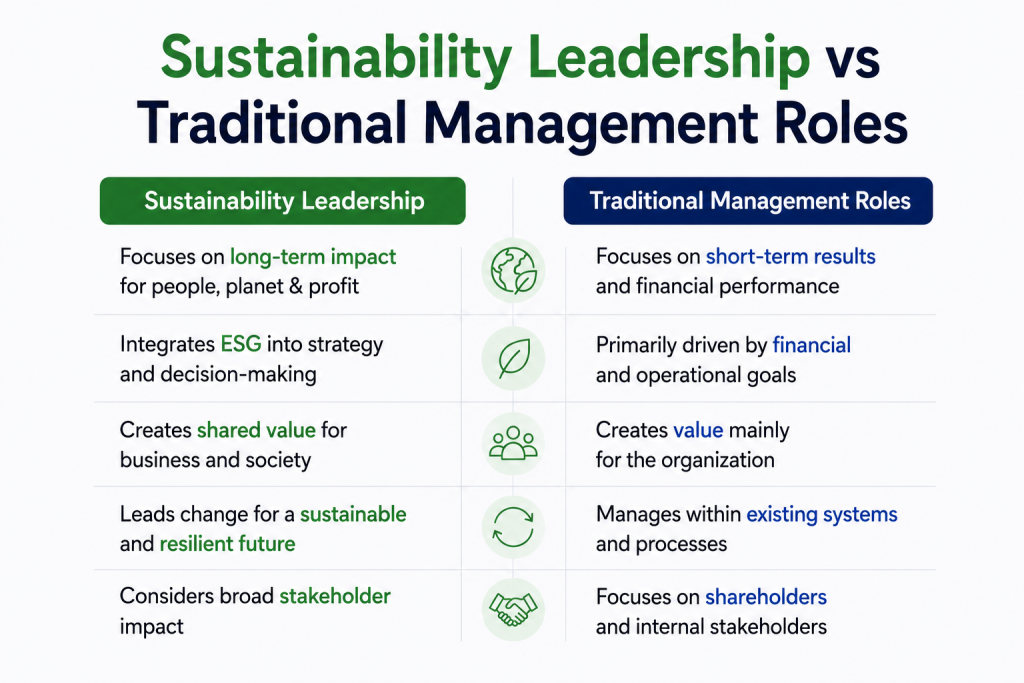
Sustainability Leadership vs Traditional Management Roles
Traditional management roles have historically focused on business growth, operational efficiency, profitability, and resource optimization. While these objectives remain important, modern business leaders are increasingly expected to balance financial performance with environmental and social responsibilities.
This shift is creating demand for professionals who understand both business management and sustainability principles. Rather than viewing sustainability as a separate initiative, organizations now integrate ESG considerations into strategic planning, risk management, investment decisions, and corporate governance frameworks.
Sustainability leaders differ from traditional managers because they evaluate decisions through a broader lens. In addition to financial outcomes, they consider long-term environmental impact, stakeholder expectations, regulatory compliance, and organizational resilience.
As sustainability becomes embedded within corporate decision-making, professionals who can combine business acumen with ESG expertise are likely to become increasingly valuable in leadership positions.
IIT Bombay Sustainability Programme vs ESG MBA Pathways
Professionals interested in sustainability education often face an important decision: should they pursue a specialized sustainability programme or an MBA with ESG-focused learning?
The answer depends on career goals.
The IIT Bombay Sustainability Leadership Programme is designed for professionals seeking focused expertise in sustainability, ESG frameworks, carbon accounting, climate strategy, and responsible business practices. It is particularly relevant for professionals who want to develop specialized knowledge while continuing to work.
An ESG-focused MBA, on the other hand, provides broader management education while incorporating sustainability concepts within areas such as finance, strategy, operations, and leadership.
Professionals seeking deeper sustainability specialization may find the IIT Bombay programme more directly aligned with their goals, while those looking for comprehensive business education may consider MBA pathways with ESG integration.
Exploring ESG-Focused MBA Options
As sustainability becomes increasingly important in business education, several universities are incorporating ESG principles into management programmes.
One notable example is the MBA ESG programme offered by Amrita Vishwa Vidyapeetham. The programme combines traditional management education with sustainability-focused concepts, helping learners understand how ESG considerations influence modern business strategy.
The Future of Carbon Accounting Careers in India
One of the most promising areas within sustainability is carbon accounting.
As governments, investors, and regulators increase pressure on organizations to measure and reduce emissions, the demand for carbon accounting expertise is expected to rise significantly.
Carbon accounting professionals help organizations:
Measure greenhouse gas emissions
Establish emissions baselines
Track sustainability performance
Support ESG disclosures
Develop decarbonization strategies
Meet regulatory reporting requirements
With many organizations committing to net-zero goals and climate action plans, carbon accounting is increasingly becoming a strategic business capability rather than a compliance exercise.
This trend is creating opportunities for professionals with expertise in sustainability reporting, climate risk assessment, emissions measurement, and ESG analytics.
Why ESG Literacy Is Becoming Essential for Corporate Leaders
A common misconception is that sustainability is relevant only for sustainability professionals.
In reality, ESG considerations increasingly influence decisions made by:
CEOs
CFOs
Operations Leaders
HR Managers
Risk Professionals
Investment Teams
Strategy Consultants
Business leaders today are expected to understand how sustainability affects organizational performance, investor expectations, customer preferences, and long-term growth.
As reporting requirements become more sophisticated and stakeholders demand greater transparency, ESG literacy is becoming an essential leadership competency rather than a specialized skill.
This is one of the primary reasons programmes focused on sustainability leadership are attracting growing interest from working professionals.
Is Sustainability Leadership Worth It in 2026?
The short answer is yes—but the reasons go beyond career opportunities alone.
Sustainability is becoming deeply integrated into how businesses operate, invest, govern, and grow. Regulatory requirements are increasing, investor expectations are evolving, and organizations are under greater pressure to demonstrate environmental and social responsibility.
Professionals who understand sustainability frameworks, ESG reporting, climate strategy, and carbon accounting are positioning themselves at the intersection of business transformation and long-term value creation.
However, sustainability leadership should not be viewed as a shortcut to career growth. Like any professional discipline, success depends on continuous learning, practical application, and the ability to translate sustainability principles into measurable business outcomes.
For professionals interested in future-focused leadership capabilities, sustainability is likely to remain one of the most important business domains of the coming decade.
Final Thoughts
The business landscape is undergoing a profound transformation. Sustainability is no longer a peripheral initiative—it is becoming a central pillar of corporate strategy, investor relations, risk management, and organizational resilience.
As ESG disclosures, climate reporting, and carbon accountability become increasingly important, organizations need professionals who can navigate these complexities while balancing business objectives and stakeholder expectations.
The Professional Certificate Programme in Sustainability Leadership by IIT Bombay offers professionals an opportunity to build expertise in ESG frameworks, sustainability strategy, carbon accounting, climate leadership, and responsible business practices. By combining sustainability concepts with practical business applications, the programme helps learners develop capabilities that are increasingly relevant across industries.
For professionals looking to future-proof their careers, strengthen leadership capabilities, and contribute to sustainable business transformation, sustainability leadership represents a compelling area of growth in 2026 and beyond.
Nuthana Reddy
Nuthana Reddy is a Senior Manager at Procter & Gamble, specializing in operations, digitization, and cross-functional leadership. She has driven multimillion-dollar impact through innovation, process optimization, and strategic execution across global markets.
Get Free Upskilling Guidance
Fill in the details for a free consultation
Related Courses
Explore our programs
Admission Closed
Professional Certificate Programme in Sustainability Leadership and Practice
 HOME > BLOG > Leadership > IIT Bombay Sustainability Leadership Programme 2026: ESG, Carbon Accounting & Climate Strategy for India’s Next Corporate Leaders
 July 3, 2026
 9 min read




 ChatGPT
 Perplexity
 Claude
 Grok
Grok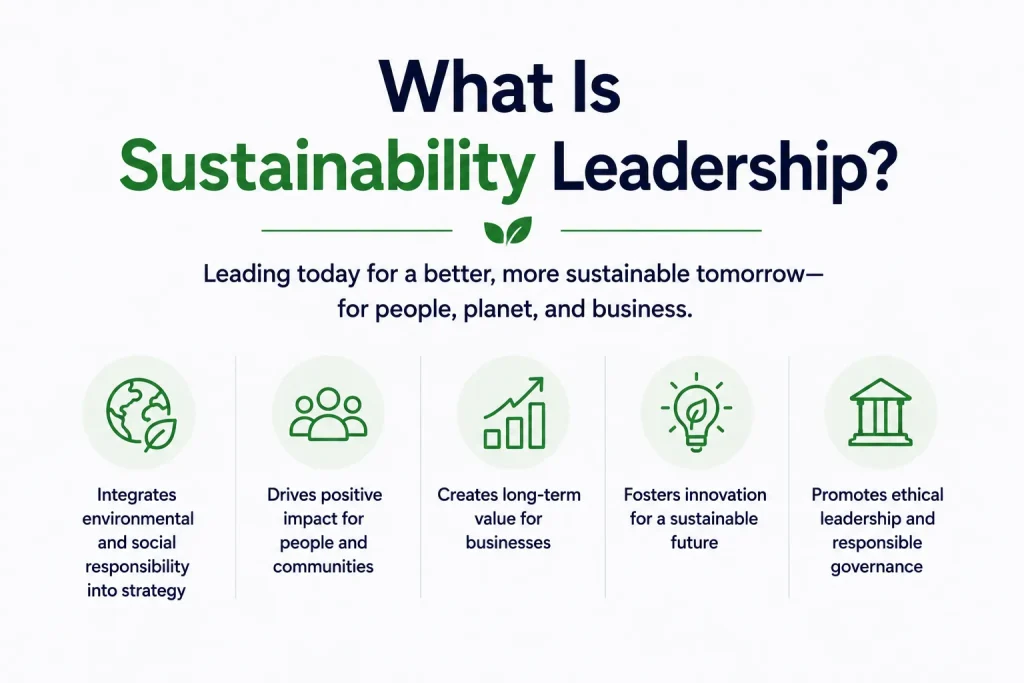




 Admission Closed
 Admission Open
 Admission Closed
 Admission Open
 ROI Calculator