Why Promotions Have Become More Competitive in 2026
Build Leadership Before You Receive the Title
Develop Strong Business Acumen
For many professionals, becoming a Senior Manager is one of the biggest milestones in their corporate journey. It represents more than a higher salary or a better designation—it reflects trust, leadership, and the ability to influence business outcomes. However, despite years of experience and consistent performance, many professionals find themselves waiting longer than expected for this promotion.
The workplace has changed significantly over the past few years. In 2026, companies are no longer promoting employees based solely on tenure or technical expertise. Organisations are looking for professionals who can lead teams, drive strategic initiatives, solve business challenges, and adapt to emerging technologies such as artificial intelligence (AI), automation, and data analytics.
This shift has made promotions more competitive but also more transparent. Professionals who consistently demonstrate business impact, leadership potential, and a growth mindset are advancing faster than ever before.
If you are aiming to move into a Senior Manager role, this guide will help you understand what organisations expect, where professionals often fall short, and what practical steps you can take to accelerate your career growth.
Many professionals assume that a Senior Manager simply performs the same work as a Manager with additional responsibilities. In reality, the role is fundamentally different.
Managers are primarily responsible for delivering projects, supervising teams, and ensuring operational efficiency. Senior Managers, on the other hand, are expected to influence business strategy, align multiple teams, manage larger budgets, mentor future leaders, and contribute directly to organisational growth.
Instead of focusing only on execution, Senior Managers spend a significant amount of time making strategic decisions. They work closely with senior leadership, identify opportunities for business improvement, manage organisational risks, and ensure that teams remain aligned with long-term objectives.
This transition requires professionals to move from being excellent individual contributors to becoming effective business leaders.
Why Promotions Have Become More Competitive in 2026
The corporate landscape is evolving rapidly. Organisations are investing heavily in digital transformation, AI-powered decision-making, customer-centric strategies, and operational excellence. As a result, companies expect managers to possess broader business capabilities than ever before.
Simply completing assigned tasks is no longer enough. Employers now evaluate professionals based on how effectively they solve business problems, improve processes, manage stakeholders, and lead cross-functional initiatives.
Hybrid work environments have also changed how leadership is measured. Senior Managers must now inspire distributed teams, maintain collaboration across locations, and ensure consistent productivity regardless of where employees work.
At the same time, businesses are becoming increasingly data-driven. Leaders are expected to support decisions with measurable outcomes rather than assumptions. Professionals who understand analytics, digital tools, and emerging technologies naturally gain a competitive advantage during promotion discussions.
Build Leadership Before You Receive the Title
One of the best ways to earn a promotion is to start behaving like a Senior Manager before officially becoming one.
Leadership is demonstrated through actions rather than job titles.
Volunteer to lead cross-functional projects, mentor junior colleagues, coordinate initiatives involving multiple departments, or represent your team during senior leadership meetings.
Taking ownership of business challenges instead of waiting for instructions signals readiness for greater responsibility.
Leaders also remain calm during uncertainty. Rather than escalating every issue, they evaluate available information, consider different perspectives, and recommend practical solutions.
Developing this mindset consistently helps decision-makers view you as someone capable of handling larger organisational responsibilities.
Develop Strong Business Acumen
Technical expertise may help professionals become managers, but business acumen often determines who becomes Senior Manager.
Organisations expect future leaders to understand how their decisions affect revenue, profitability, customer satisfaction, operational efficiency, and long-term growth.
This requires looking beyond daily operational tasks.
Spend time understanding your organisation’s business model, financial performance, competitors, market trends, customer expectations, and industry challenges.
Professionals who connect departmental initiatives with organisational goals naturally become stronger promotion candidates because they contribute strategic value rather than operational support.
Business acumen also improves communication with senior leadership by enabling discussions focused on outcomes instead of activities.
Strengthen Your Decision-Making Skills
Senior Managers make decisions that influence teams, customers, budgets, and organisational performance.
Consequently, decision-making becomes one of the most closely evaluated leadership competencies.
Strong decision-makers gather relevant information, assess risks, evaluate alternatives, and make timely choices without unnecessary delays.
They also understand that not every decision will be perfect. Instead of seeking complete certainty, they make informed decisions based on available evidence while remaining flexible enough to adjust when new information emerges.
Developing this capability requires continuous learning, curiosity, and confidence.
Professionals who consistently make thoughtful decisions gradually earn the trust of senior leadership.
As responsibilities increase, managing stakeholders becomes just as important as managing teams.
Senior Managers regularly collaborate with executives, clients, department heads, external partners, and cross-functional teams. Each stakeholder has different priorities, expectations, and communication styles.
Successful professionals learn how to balance these expectations while maintaining alignment with organisational objectives.
Effective stakeholder management begins with listening carefully, understanding concerns, communicating transparently, and resolving conflicts professionally.
Building trust across departments also creates stronger collaboration, making it easier to execute strategic initiatives successfully.
In many organisations, professionals who excel at stakeholder management progress faster because they enable smoother decision-making across the business.
Become Comfortable With AI and Digital Transformation
Technology is reshaping leadership expectations.
Today’s Senior Managers are expected to understand how AI, automation, analytics, and digital tools improve business performance.
This does not mean becoming a software engineer or data scientist.
Instead, leaders should know how technology can improve customer experiences, increase productivity, reduce operational costs, support better decision-making, and create competitive advantages.
Professionals who actively embrace digital transformation are often viewed as future-ready leaders capable of guiding organisations through change.
Understanding AI-enabled decision-making, predictive analytics, workflow automation, and digital collaboration platforms will become increasingly valuable over the coming years.
Communicate Like a Leader
Communication becomes increasingly important as professionals move toward senior leadership positions.
Senior Managers spend less time performing operational tasks and more time influencing people.
Whether presenting business proposals, handling conflicts, mentoring teams, or speaking with executives, clear communication builds credibility.
Future leaders learn how to simplify complex ideas, communicate with confidence, and adapt their messaging to different audiences.
Listening is equally important.
Professionals who actively seek feedback, encourage collaboration, and understand different viewpoints build stronger relationships across the organisation.
Effective communication ultimately strengthens leadership presence, one of the most overlooked factors influencing promotions.
One of the defining qualities of successful Senior Managers is executive presence. It is not about being the loudest person in the room or having the most years of experience. Instead, it is about earning the confidence of peers, team members, and senior leaders through professionalism, credibility, and consistency.
Executive presence develops through the way you communicate, handle pressure, and make decisions. Professionals who remain composed during challenging situations, present ideas with clarity, and inspire confidence are often considered ready for leadership roles. They also demonstrate accountability by owning both successes and setbacks instead of shifting responsibility to others.
Developing executive presence takes time, but it begins with small, consistent actions. Speak with confidence during meetings, support your ideas with data, and focus on solutions rather than problems. These habits gradually establish your reputation as someone who can lead larger teams and strategic initiatives.
Focus on Business Impact, Not Just Activity
Many professionals work extremely hard but struggle to demonstrate the value of their contributions. One reason promotions are delayed is that performance reviews often focus on measurable business outcomes rather than effort alone.
Instead of listing the tasks you completed, highlight the impact your work created. Did your project improve operational efficiency? Did it reduce costs, increase revenue, improve customer satisfaction, or shorten delivery timelines? Quantifying your achievements helps leadership understand the value you bring to the organisation.
Another way to create business impact is by identifying opportunities before they become problems. Professionals who proactively improve processes, optimise workflows, or recommend innovative solutions are often recognised as strategic thinkers. These contributions demonstrate that you are focused on the organisation’s long-term success rather than simply completing assigned responsibilities.
The responsibilities of Senior Managers continue to evolve as businesses adopt new technologies, changing customer expectations, and modern leadership practices. Professionals who continuously update their skills remain more competitive during promotion cycles.
Leadership development today extends beyond technical expertise. Strategic thinking, financial acumen, digital transformation, AI adoption, change management, negotiation, stakeholder management, and business communication have become essential competencies for senior leadership roles.
Executive education programmes, leadership certifications, and industry-specific learning opportunities can help professionals strengthen these capabilities while broadening their perspective. Continuous learning also demonstrates initiative and a willingness to adapt—qualities that organisations highly value in future leaders.
Build Relationships Across the Organisation
Career growth is rarely achieved in isolation. Professionals who collaborate effectively across departments often gain broader visibility and stronger support during promotion discussions.
Take the initiative to work with colleagues from different functions, participate in cross-functional projects, and contribute to organisational initiatives beyond your immediate responsibilities. These experiences help you understand how different teams operate and improve your ability to lead diverse groups in the future.
Strong professional relationships also make it easier to influence decisions, resolve conflicts, and execute large-scale projects. Building trust across the organisation positions you as a collaborative leader who can unite teams toward shared goals.
Seek Feedback and Act on It
One habit shared by successful leaders is their willingness to seek constructive feedback. Rather than waiting for annual performance reviews, they actively ask managers, peers, and mentors for suggestions on how they can improve.
Receiving feedback is only the first step. Demonstrating visible improvement after receiving feedback shows maturity, adaptability, and commitment to professional growth. Organisations are more likely to promote individuals who consistently learn from experience and embrace change.
Regular self-assessment can also help identify areas for development. Reflecting on your leadership style, communication skills, decision-making ability, and business knowledge allows you to focus your learning efforts more effectively.
Advance Your Leadership Journey with IIM Tiruchirappalli
If you’re aspiring to step into senior leadership roles, the Post Graduate Certificate in Senior Management Programme by IIM Tiruchirappalli, offered through Jaro Education, can help you build the strategic capabilities needed for career advancement. Designed for experienced professionals, the programme focuses on leadership, strategic management, business transformation, financial decision-making, innovation, digital strategy, and organisational growth. Through live online learning, insights from renowned IIM Tiruchirappalli faculty, practical business applications, and peer networking, participants gain the skills and confidence required to lead teams, drive business impact, and prepare for senior management responsibilities in today’s evolving corporate landscape.
Conclusion
Getting promoted to Senior Manager in 2026 requires much more than experience and consistent performance. Organisations are looking for professionals who think strategically, lead confidently, embrace change, and create measurable business value. The transition from Manager to Senior Manager is ultimately about shifting from executing tasks to influencing business outcomes and developing future leaders.
While promotions are never guaranteed, professionals who continuously improve their leadership skills, strengthen business acumen, build cross-functional relationships, and invest in learning significantly increase their chances of success. Career growth is a continuous journey, and every project, challenge, and learning opportunity contributes to preparing you for greater responsibilities.
Frequently Asked Questions
While it varies by industry and organisation, most professionals move into Senior Manager roles after demonstrating consistent leadership, business impact, and strategic thinking over several years of managerial experience.
Leadership, stakeholder management, strategic thinking, financial acumen, communication, data-driven decision-making, and the ability to lead cross-functional teams are among the most sought-after skills.
Yes. Executive education programmes help professionals strengthen leadership capabilities, gain strategic business knowledge, and demonstrate a commitment to continuous learning, all of which can support career advancement.
Many professionals focus only on operational performance without demonstrating leadership potential, business impact, cross-functional collaboration, or strategic thinking—all of which are critical for senior management roles.
Absolutely. Senior Managers are increasingly expected to understand how AI, automation, and data analytics can improve decision-making, operational efficiency, customer experience, and business growth.
Bhargavi R
HR Professional
Bhargavi Reddy is an HR professional with over 6 years of experience in IT recruitment and talent acquisition. She specializes in hiring across technologies like Java, DevOps, Python, and Data Engineering. With strong expertise in full-cycle recruitment and stakeholder management, she focuses on building high-performing teams. Currently, she works as an HR Manager driving strategic hiring initiatives.
Get Free Upskilling Guidance
Fill in the details for a free consultation
Related Courses
Explore our programs
Post Graduate Certificate in Senior Management Programme
 HOME > BLOG > Career Development > How to Get Promoted to Senior Manager in India – The Honest Guide for 2026
 August 7, 2026
 8 min read





 ChatGPT
 Perplexity
 Claude
 Grok
Grok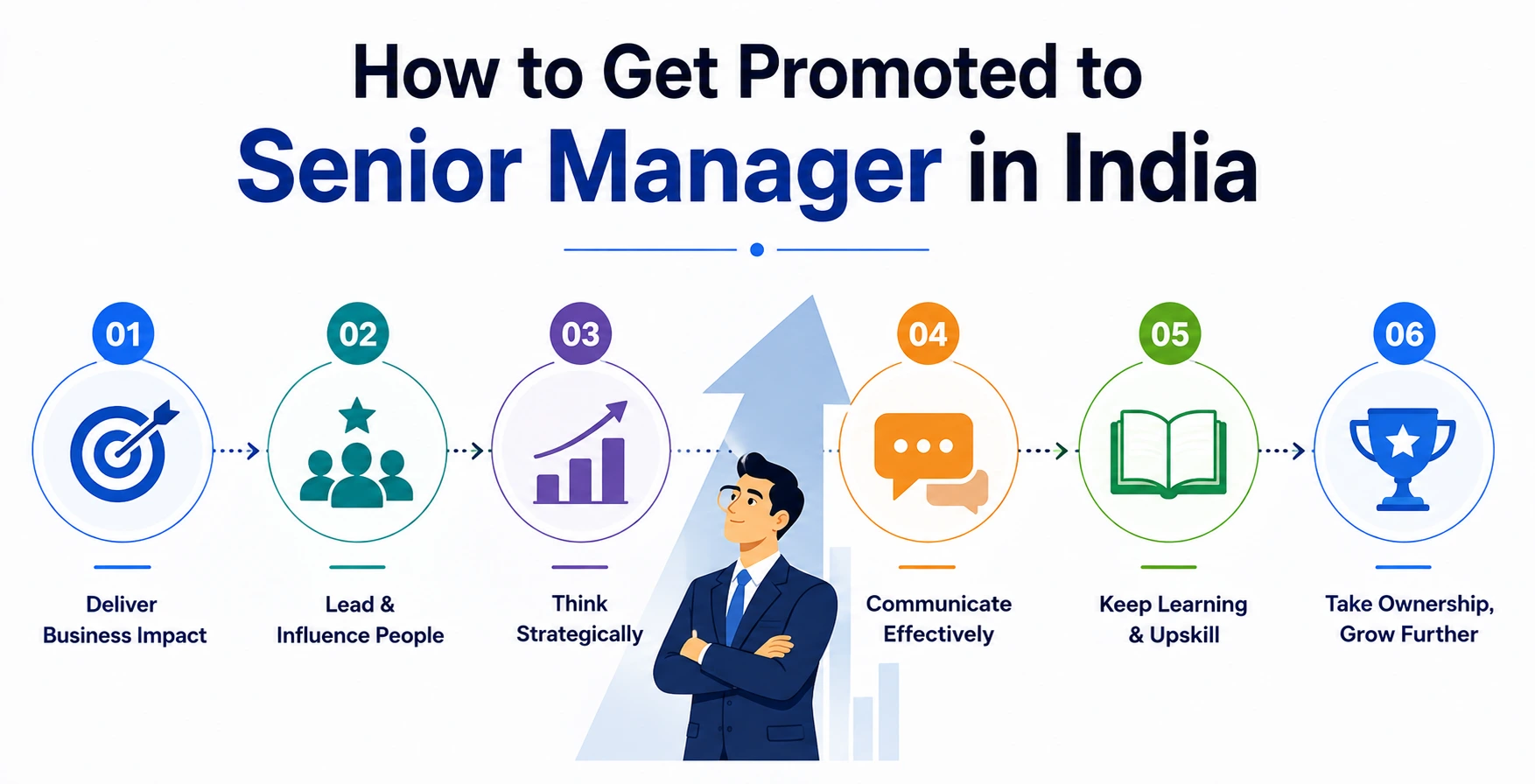








 ROI Calculator