Whether you are switching jobs, applying for a visa, or pursuing higher education, one document that invariably comes up is the experience letter. It is one of the most requested professional documents in the corporate world, yet many employees and HR managers are unsure about exactly what it should contain, how it should look, and what makes it legally credible. In this comprehensive guide, we break down everything you need to know — from the correct experience letter format, to writing one from scratch, to reviewing a ready-to-use sample.
If you are an HR professional, a manager handling exit formalities, or an employee on the verge of a job transition, this blog is your one-stop reference. And if you are also looking to upgrade your skills and increase your market value before your next career move, explore how Jaro Education's career-focused programmes can give you a competitive edge.
An experience letter — also called a work experience letter or service certificate — is a formal document issued by an employer to an employee upon leaving the organisation. It certifies the tenure and nature of the employee’s service and is considered an official record of professional employment.
Unlike a relieving letter (which focuses on the exit), an experience letter details the employee’s role, duration of service, and sometimes their performance and character. It serves multiple purposes:
Proof of employment for future employers during background verification
Required documentation for higher education admissions
Essential for visa and immigration applications
Supporting evidence during loan applications
Useful for salary benchmarking and negotiations
Many professionals confuse an experience letter with an experience certificate letter. While both terms are used interchangeably, an experience certificate letter is essentially the same document — a formal certificate that validates an individual’s work history. Some organisations issue them as a standalone certificate rather than a letter, but the content and purpose remain the same.
Why the Experience Letter Format Matters
The format of an experience letter matters more than most people realise. A poorly structured or incomplete letter can raise red flags during background checks, delay visa processing, or cause rejection during university admissions.
Here is why getting the experience letter format right is essential:
Credibility: A well-structured letter on official letterhead signals professionalism and authenticity.
Legal validity: Including key details — dates, designation, and signature — ensures the letter holds up during verification.
Clarity for the recipient: Background verification teams and visa officers deal with hundreds of documents. A clear, standardised format saves time and reduces back-and-forth queries.
Positive brand image: For companies, issuing a clean, professional experience letter reflects well on their HR practices and employer brand.
Many HR teams make the mistake of using generic templates that miss critical details. If you are an HR professional looking to sharpen your documentation and communication skills, Jaro Education’s free online courses on communication and stakeholder management can be a great starting point.
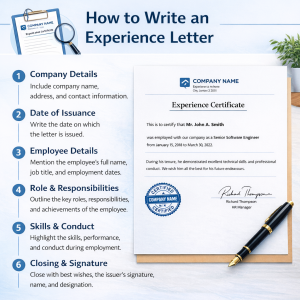
Whether you are writing an experience letter from scratch or reviewing an existing template, make sure the following components are present:
1. Company Letterhead
The letter should always be printed on the company’s official letterhead, which includes the company name, logo, registered address, and contact details. This is a non-negotiable element of any credible experience letter format.
2. Date of Issue
The date on which the letter is being issued must be clearly mentioned. This is important for verifying the timeline of employment and for time-sensitive applications such as visa or admission forms.
3. Salutation or ‘To Whom It May Concern’
Since the letter may be addressed to multiple future recipients (employers, embassies, universities), it is standard practice to use “To Whom It May Concern” unless the recipient is known.
4. Employee Details
The letter must include the full name of the employee, their employee ID (if applicable), their designation or job title, and the department they worked in.
5. Dates of Employment
Both the joining date and the last working date must be specified. These dates are cross-checked by background verification agencies and should match the employee’s records accurately.
6. Nature of Work / Key Responsibilities
While not always mandatory, briefly mentioning the employee’s role and key responsibilities adds context and value to the letter. This is especially helpful for employees applying to roles in the same domain.
7. Character and Performance Remarks (Optional)
Some organisations choose to include a brief statement about the employee’s conduct, dedication, and overall performance. While optional, this adds a personal touch and can strengthen the employee’s credibility.
8. Well-Wishing Statement
A polite closing statement wishing the employee well in future endeavours is standard professional courtesy and rounds off the letter positively.
9. Authorised Signatory
The letter must be signed by an authorised person — typically the HR Manager, Department Head, or a Director. The signatory’s name, designation, and contact information should be clearly mentioned below the signature. A company stamp or seal adds further authenticity.
Experience Letter Format in Word – What to Expect
Many HR professionals and employees search specifically for the experience letter format in Word because editable templates save significant time. When downloading or creating an experience letter format in Word, ensure the following:
Use a standard, professional font such as Arial or Times New Roman, size 11–12.
Maintain standard margins (1 inch on all sides) for a clean appearance.
Align the company letterhead at the top, followed by the date and the body of the letter.
Use single or 1.15 line spacing within paragraphs and double spacing between sections.
Save the final version as both a .docx and a PDF to prevent accidental edits.
A properly formatted experience letter format in Word not only looks professional but also ensures consistent output every time HR needs to issue one. It is advisable for organisations to create a standardised template and save it in their HR systems.
If you are a working professional trying to navigate tools like Word, Excel, and communication platforms more effectively, Jaro Education offers programmes that include practical corporate skills development. Check out the best courses by Jaro Education for career growth.
Experience Letter Sample
Below is a ready-to-use experience letter sample that you can adapt according to your organisation’s requirements:
Subject: Experience Certificate for [Employee Full Name]
This is to certify that [Employee Full Name], bearing Employee ID [XXXX], has been employed with [Company Name] from [Joining Date] to [Last Working Date] in the capacity of [Designation] in the [Department Name] department.
During their tenure with us, [Employee First Name] demonstrated commendable professionalism, dedication, and a strong work ethic. Their key responsibilities included [brief description of role and responsibilities, e.g., managing client relationships, leading a team of 8 professionals, overseeing digital marketing campaigns, etc.].
[Employee First Name] has consistently maintained a high standard of integrity and performance. We are pleased to confirm that their conduct throughout the period of employment has been satisfactory, and they have no outstanding dues or obligations towards the organisation.
We wish [Employee First Name] all the very best in their future professional endeavours.
Yours sincerely,
[Authorised Signatory Name]
[Designation]
[Company Name]
[Date] | [Signature & Company Seal]
The above experience certificate letter template can easily be adapted for any industry. Replace the bracketed placeholders with accurate employee and company information before issuing the document.
How to Write an Experience Letter: Step-by-Step
Writing a professional experience letter does not need to be complicated. Follow these steps for a smooth and accurate output:
Collect accurate employee data: Before writing, pull up the employee’s official records — joining date, last working day, designation(s) held, department, and employee ID.
Use the official letterhead: Always draft the experience letter on the company’s official letterhead. Avoid using plain paper or generic formats without branding.
Keep the language formal and neutral: Avoid overly casual language or extremely personalised opinions. Stick to factual, formal language that is appropriate for official documentation.
Verify dates carefully: Errors in dates are the most common mistake in experience letters and can cause serious issues during background checks. Double-check joining and exit dates against HR records.
Include an optional performance statement: A brief, positive remark about the employee’s contributions adds value without overpromising. Keep it concise and professional.
Get it signed by an authorised person: The letter is only valid when signed by an authorised representative of the company. Ensure their name, designation, and contact details are included.
Issue in a sealed envelope or as a secured PDF: For added credibility, issue physical letters in a sealed company envelope or as a digitally signed/stamped PDF.
Even experienced HR professionals sometimes make avoidable errors. Here are the most common mistakes to watch out for:
Wrong dates: As mentioned, incorrect joining or leaving dates can be disqualifying during background verification.
Missing designation: Always specify the most recent or primary designation held.
No signature or company seal: An unsigned letter is considered invalid by most organisations and institutions.
Vague job description: If you choose to include responsibilities, make sure they are specific and accurate.
Issuing without HR approval: The letter should always go through proper internal approval channels before being issued.
Not retaining a copy: Always keep a copy of every issued experience letter in the employee’s exit file.
Difference Between an Experience Letter and a Relieving Letter
These two documents are often confused but serve different purposes:
Experience Letter vs Relieving Letter
An experience letter certifies the nature and duration of work performed. A relieving letter formally acknowledges that the employee has been relieved of their duties.
An experience letter is issued for use with future employers, educational institutions, or visa applications. A relieving letter confirms the completion of the notice period and exit formalities.
An experience letter may include performance remarks. A relieving letter typically does not.
Both documents are usually issued together during exit formalities, but they serve distinct administrative purposes.
If you are a professional navigating a career transition and want to understand exit formalities, compensation, and career planning better, consider reviewing resources at Jaro Education’s career counselling and upskilling blog.
Free Courses
Stakeholder Communication & Negotiation Skill Sets
After all exit formalities — including asset return, knowledge transfer, and final settlement — have been completed
Upon written or official request from the employee if not issued proactively
In case of redundancy or layoff, along with the relieving letter and final settlement documents
Delaying the issuance of an experience letter can be legally problematic in several jurisdictions. Organisations should have a clear exit process policy that mandates the timely issuance of all documents, including the experience certificate letter.
Tips for Employees: How to Request an Experience Letter
If your employer has not proactively issued your experience letter, here is how to request one professionally: Submit a formal written request to your HR department or reporting manager. Mention your full name, employee ID, designation, and the dates of your employment clearly. Reference the purpose for which you need the letter (visa application, job application, etc.) so HR can prioritise accordingly. Follow up politely if you do not receive a response within a reasonable timeframe (typically 5–7 business days). Once received, review all details carefully — especially dates and designation — before using the document. For professionals looking to take their careers to the next level after a job transition, this is also a great time to evaluate upskilling opportunities. Jaro Education offers executive programmes in collaboration with top-tier institutions like IIMs. Learn how to leverage your experience effectively with placement preparation strategies recommended by career experts.
Experience Letter in the Digital Age
With remote work and digital hiring processes becoming the norm, experience letters are increasingly being issued in digital formats. Here is what you should know:
Digital experience letters should ideally carry a digital signature from an authorised company representative.
Some organisations use blockchain-based credential verification to ensure authenticity.
PDF format with embedded metadata is preferred over scanned image formats, as it is harder to tamper with.
LinkedIn’s employment history and Aadhaar-linked DigiLocker are emerging as supplementary options for verifying employment in India, but do not yet replace the formal experience letter.
As hiring practices evolve, both employees and HR professionals must stay current. Jaro Education’s programmes equip professionals with the skills to adapt to a modern, digital-first work environment. Explore options on the Jaro Education blog for the latest career and industry insights.
Conclusion
An experience letter is more than a formality — it is an official record of your professional journey and a document that will follow you throughout your career. Whether you are an HR professional drafting one or an employee requesting it, understanding the correct experience letter format ensures the document serves its purpose effectively.
Use this guide to create experience letters that are professional, credible, and legally sound. Whether you prefer an experience letter format in Word or a PDF, what matters most is accuracy, completeness, and authenticity.
If you are at a career inflection point and want to ensure your skills match your ambitions, remember that a strong professional foundation goes beyond paperwork. Explore Jaro Education’s upskilling programmes designed for working professionals across industries. Whether you are eyeing a promotion, a career switch, or a salary jump, Jaro has a perfect programme tailored for you.
Frequently Asked Questions
While there is no universal law mandating experience letters in India, many company HR policies and professional norms require them. Most background verification agencies will flag missing experience documentation.
Yes, employees can request an experience letter even years after leaving a company, though the process may take longer. It is advisable to request one at the time of exit to avoid complications.
If an employer unjustifiably refuses, you can escalate the matter through formal HR channels, legal notices, or approach the labour commissioner in your jurisdiction.
Yes. An experience certificate letter is a factual document certifying employment. A recommendation letter is a personal endorsement from a manager or colleague, often subjective and aimed at highlighting your strengths.
Some organisations include a salary statement within the experience letter, but it is not a standard practice. Salary details are usually provided through a separate salary slip or offer letter.
Prerna Singh
Talent Acquisition Manager - India
Prerna Singh is a results-driven Talent Acquisition Manager with expertise in end-to-end HR management. She has a strong background in recruitment, employee engagement, and HR operations across IT domains. Skilled in ATS/HRIS platforms and vendor management, she is passionate about building productive workplaces. She is committed to aligning talent strategies with business growth.
Get Free Upskilling Guidance
Fill in the details for a free consultation
Related Courses
Explore our programs
Admission Closed
Strategic Leadership Programme for Women Executives

 March 18, 2026
 10 min read





 ChatGPT
 Perplexity
 Claude
 Grok
Grok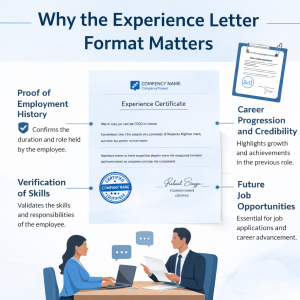






 Admission Closed
 Admission Open
 Admission Closed
 Admission Closed
 ROI Calculator