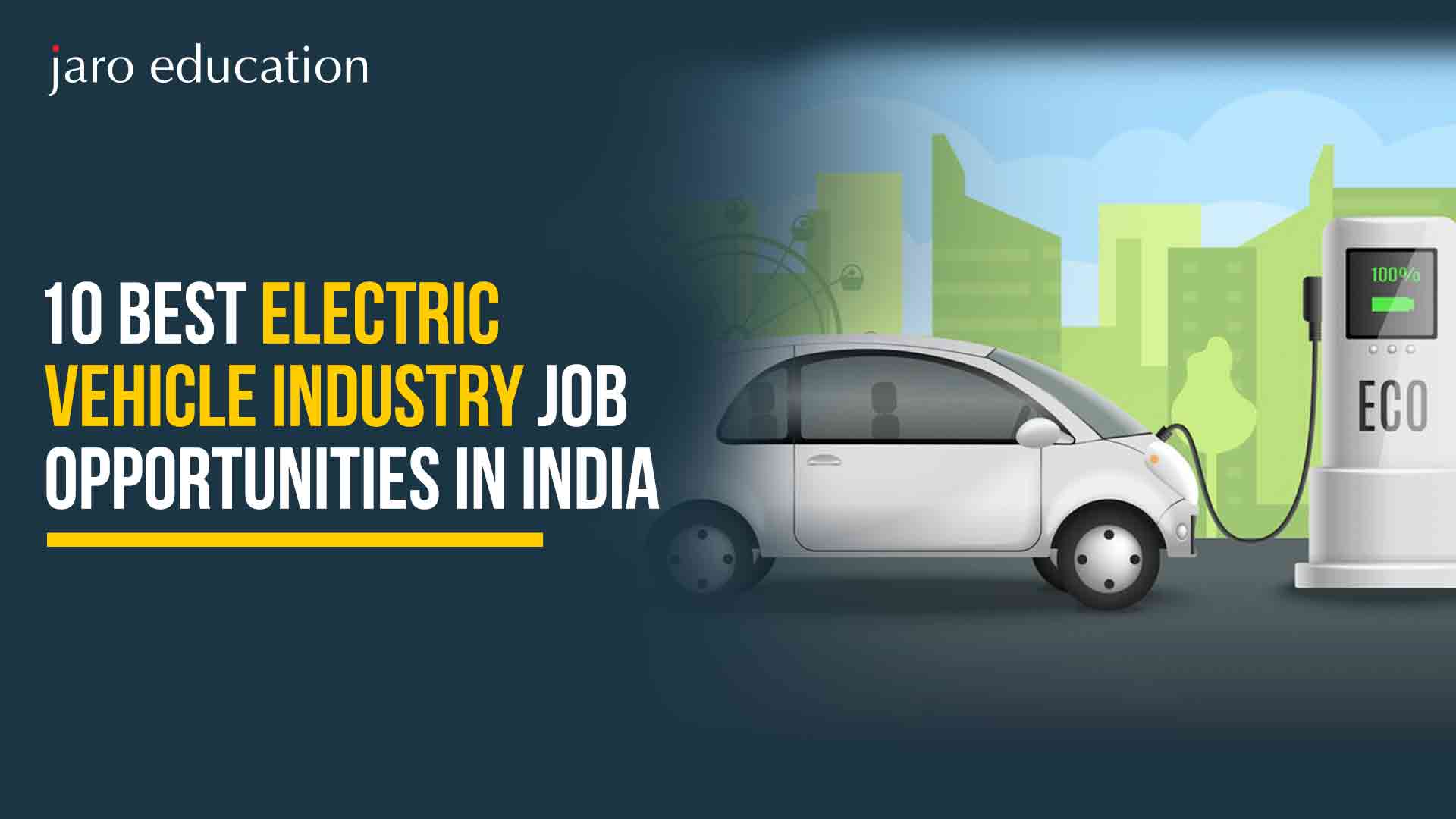
10 Best Electric Vehicle Industry Job Opportunities in India
J
By Jaro Education
April 28, 20255 min read
Last updated on September 10, 2026
SHARE THIS ARTICLE
Table Of Content
Top 10 Job Opportunities in the Electric Vehicle Industry in 2026
How to Build a Successful Career in the Electric Vehicle Industry
Advance Your Career with the Advanced Programme in Electric Vehicle (EV) Technology by IIT Delhi
Conclusion
If you’ve seen green number plates and silent scooters around you, you’ve probably noticed the electric vehicle industry revolution already. The electric vehicle industry is smarter, doesn’t use up fossil fuels, does not pollute the air, does not cause noise pollution, and has every feature that traditional vehicles have. The best part? All you have to do is charge your vehicle, like your phone, and boom, it’s ready to use! No spending tons of money on petrol.
It’s obvious that the electric vehicle industry in India is expected to soar in the coming times, the key drivers being government incentives, the drive for sustainability, and technological advancements. The need for skilled professionals in the electric vehicle industry is also rising day by day, to help make these vehicles smarter and better.
In this blog, we explore the top 10 electric vehicle jobs in India that you can land and also introduce you to a top programme in EV technology so that you can upskill and prepare yourself for these roles. So, let’s dive in!
Top 10 Job Opportunities in the Electric Vehicle Industry in 2026
The electric vehicle industry is not just revolutionizing transportation—it’s transforming the global job market. As governments set ambitious EV adoption targets and automakers rapidly shift from fossil-fuel engines to electric mobility, the demand for skilled professionals is soaring. By 2026, the electric vehicle market will require a massive workforce with expertise spanning engineering, software development, manufacturing, infrastructure, and policy.
With companies like Tesla, Tata Motors, Ola Electric, Rivian, and BYD aggressively expanding their EV operations, career opportunities in this sector have never been more promising. Whether you’re a fresh graduate looking for a future-proof career or a professional considering an industry switch, the EV market offers high-growth prospects with excellent salary potential.
Here’s a deep dive into the top 10 job opportunities in the electric vehicle industry in 2026—roles that will shape the future of sustainable mobility and redefine transportation as we know it.
*www.silverpeople.in
1. EV Battery Engineer
What They Do:
Batteries are the backbone of the electric vehicle industry, determining an EV’s range, efficiency, and overall performance. EV battery engineers specialize in designing, testing, and improving lithium-ion and emerging solid-state batteries to enhance energy storage, longevity, and charging speed.
Required Skills:
Battery chemistry and materials science
Thermal management systems
Energy storage and power density optimization
Battery management systems (BMS)
Career Outlook:
As battery efficiency and sustainability become critical for widespread EV adoption, the demand for skilled battery engineers is skyrocketing. Companies are investing heavily in next-gen batteries, making this a lucrative and high-impact career path.
2. Electric Powertrain Engineer
What They Do:
The electric powertrain replaces the traditional internal combustion engine, and its optimization is key to an EV’s efficiency, speed, and reliability. Powertrain engineers design and enhance motors, inverters, controllers, and regenerative braking systems to improve performance.
Required Skills:
Power electronics and motor design
Electrical engineering and high-voltage systems
Thermal and energy efficiency management
MATLAB, Simulink, and embedded systems
Career Outlook:
With EV manufacturers focusing on high-performance, long-range, and cost-effective electric propulsion systems, electric powertrain engineers are in high demand across automakers, startups, and research institutions.
10. EV Policy & Regulatory Analyst
What They Do:
Government policies and environmental regulations heavily influence the electric vehicle industry. Policy analysts ensure companies stay compliant with evolving emission laws, incentives, and EV-friendly regulations.
Required Skills:
Government policies and automotive laws
Emission regulations and carbon credit systems
Policy impact analysis and lobbying strategies
Public-private partnerships for EV adoption
Career Outlook:
As countries push for 100% electric mobility, regulatory analysts will play a key role in shaping industry standards and policy frameworks.
How to Build a Successful Career in the Electric Vehicle Industry
The electric vehicle industry is booming, and if you want to make your mark in this fast-growing sector, upskilling is the way to go. The demand for professionals in EV battery technology, power electronics, charging infrastructure, and autonomous driving is skyrocketing. Companies in the electric vehicle industry aren’t just looking for degrees—they need people with hands-on expertise in real-world EV projects, advanced software tools, and innovative problem-solving skills.
To stand out, you need to master industry-specific skills tailored for different EV job roles. If you’re interested in EV battery development, knowledge of lithium-ion chemistry, battery management systems (BMS), and energy storage is crucial. For those looking to get into EV powertrain engineering, expertise in motor controllers, regenerative braking, and thermal management will give you a competitive edge. Meanwhile, professionals keen on EV charging infrastructure need to be familiar with grid integration, fast-charging technology, and smart energy solutions.
However, skills alone aren’t enough—you need practical experience. Internships, hands-on projects, and research in electric vehicle technology will not only enhance your knowledge but also make you more attractive to top employers in the electric vehicle industry. Working on real-world EV applications, prototyping battery systems, or contributing to smart charging solutions will significantly boost your credibility in this space.
Advance Your Career with the Advanced Programme in Electric Vehicle (EV) Technology by IIT Delhi
If you’re serious about building a successful career in the electric vehicle industry, enrolling in the right training programme can set you apart. The Advanced Programme in Electric Vehicle (EV) Technology by IIT Delhi with Jaro Education as service partner is designed to equip you with cutting-edge expertise in EV design, battery technology, power electronics, and smart transportation solutions.
Why Choose This Programme?
Learn from Industry Experts: Get trained by leading IIT Delhi faculty and professionals working in the electric vehicle industry.
Hands-on Training: Gain real-world experience in EV design, battery optimization, power electronics, and grid integration.
Certification from IIT Delhi: A prestigious certification that enhances your credibility in the electric vehicle industry.
Industry-Relevant Curriculum: The course covers everything from EV motors and battery management systems to charging infrastructure and autonomous mobility.
With the electric vehicle industry evolving rapidly, having a strong foundation in advanced EV technology will open doors to top-tier job opportunities, giving you a significant edge over the competition.
The electric vehicle industry is redefining the future of transportation, and by 2026, the demand for skilled EV professionals will be at an all-time high. Whether you’re interested in EV battery engineering, powertrain development, charging infrastructure, or autonomous vehicle technology, upskilling is the key to securing a high-growth career.
To stay ahead, investing in the right education and hands-on training is essential. The Advanced Programme in Electric Vehicle (EV) Technology by IIT Delhi & Jaro Education offers the perfect opportunity to gain expertise in electric vehicle design, cutting-edge battery technology, and smart energy systems.
If you’re ready to make a mark in the electric vehicle industry, this is your chance. Future-proof your career, stay ahead of the curve, and become a leader in EV innovation.
Frequently Asked Questions
The electric vehicle industry is expanding at an unprecedented rate. As of 2024, the global EV market is valued at over $500 billion and is expected to surpass $1.5 trillion by 2030. With governments worldwide pushing for cleaner transportation, the EV industry is experiencing exponential growth. In India alone, the EV market is projected to reach ₹50,000 crore ($6 billion) by 2025, with a CAGR of over 40%. The rising adoption of electric cars, two-wheelers, commercial EVs, and charging infrastructure is fueling this transformation.
The electric vehicle industry is dominated by major players across the globe. Companies leading the charge include:
Tesla – The global frontrunner in EVs, known for its innovation in battery technology and autonomous driving.
BYD (China) – One of the largest EV manufacturers, backed by Warren Buffett.
Volkswagen Group – Investing billions in EV production under brands like Audi, Porsche, and Skoda.
Tata Motors (India) – Leading the Indian EV industry with models like the Nexon EV and Tigor EV.
Ola Electric (India) – A rising force in the two-wheeler EV segment.
Rivian & Lucid Motors (USA) – Disrupting the premium EV market.
With global automakers and startups alike investing heavily in EV technology, competition in the electric vehicle industry is fiercer than ever.
The future of the electric vehicle industry is electrifying—literally! By 2030, EVs are expected to make up over 50% of global vehicle sales, driven by falling battery costs, government incentives, and increasing consumer demand for sustainable transportation.
Key trends shaping the future of the EV industry include:
Solid-state battery breakthroughs – Offering longer range and faster charging.
Expansion of EV charging networks – Making EVs more accessible worldwide.
Rise of autonomous electric vehicles – Combining AI with EV technology for self-driving cars.
Integration with renewable energy – EVs working with solar and wind power for a greener future.
Government policies & incentives – Countries like the US, China, and India are introducing stricter emissions regulations and subsidies for EV adoption.
With rapid advancements in EV battery technology, infrastructure, and AI-driven automation, the electric vehicle industry is set to revolutionize transportation globally.
The electric vehicle industry is currently in a high-growth phase, with record-breaking sales worldwide. In 2023, over 14 million EVs were sold globally, making up 18% of total car sales. The momentum is even stronger in China, Europe, and the US, where government policies are driving mass adoption.
In India, the EV industry is picking up speed, with a 223% growth in electric two-wheeler sales and massive investments from companies like Tata Motors, Mahindra Electric, and Ola Electric. The government’s FAME II scheme and state subsidies are further accelerating the transition to EVs.
The charging infrastructure is also expanding, with companies setting up fast-charging stations and battery-swapping networks to support widespread EV adoption. With new models, better range, and reduced costs, the electric vehicle industry is stronger than ever and poised for long-term dominance.
Get Free Upskilling Guidance
Fill in the details for a free consultation
Related Courses
Explore our programs
Advanced Certificate Programme in Machine Learning, Gen AI & LLMs for Business Applications
 HOME > BLOG > Electric Vehicle Technology > 10 Best Electric Vehicle Industry Job Opportunities in India
 April 28, 2025
 5 min read




 ChatGPT
 Perplexity
 Claude
 Grok
Grok










 ROI Calculator