Customer Relationship Management Roles and Responsibilities
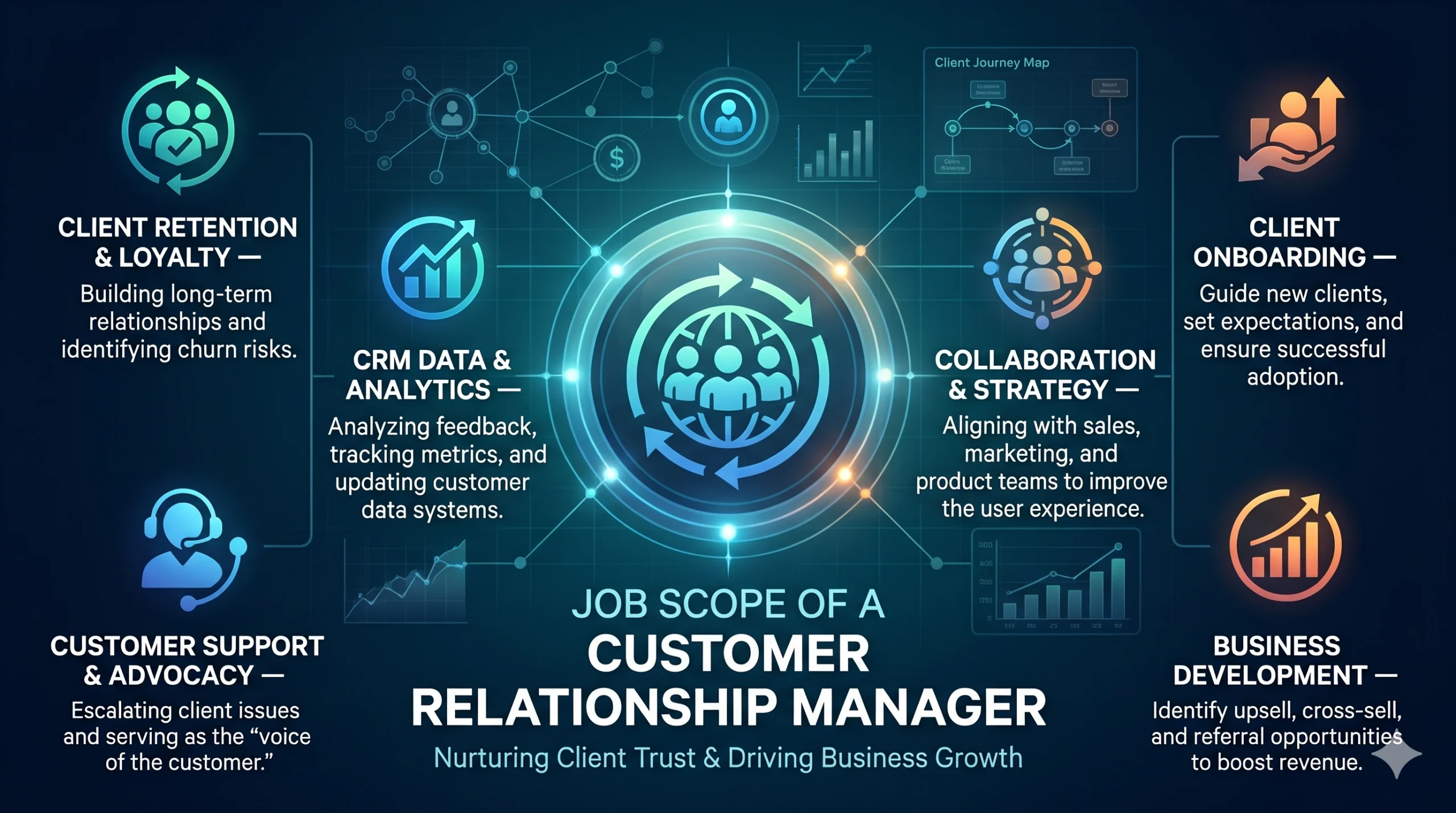
Job Scope of a Customer Relationship Manager
Key Insights
Customer Relationship Management (CRM) focuses on building, maintaining, and strengthening customer relationships through effective communication, personalized service, and customer data management.
Customer relationship managers handle key responsibilities such as understanding customer needs, resolving complaints, managing CRM data, retaining customers, and identifying upselling opportunities.
The role covers the entire customer journey, including onboarding, ongoing support, account growth, renewals, and customer retention.
Strong communication, active listening, empathy, problem-solving, negotiation, and CRM software knowledge are essential skills for succeeding in this role.
In this blog, you'll learn what a Customer Relationship Manager does, their roles and responsibilities, job scope, key skills, career path, common challenges, and the difference between a client relationship executive and a manager.
Every successful business depends on one simple thing: customers who feel valued and choose to return. Winning a new customer is important, but keeping that customer happy over the long term is what builds steady growth. This is exactly where a customer relationship manager steps in. Whether you are a student exploring career options, a professional planning a role change, or a business owner building a team, understanding this position will help you make better decisions. In this blog, we explain who acustomer relationshipmanager is, what the job involves, and how customer relationship management supports business success.
Customer relationship management, often shortened to CRM, is the practice of building, maintaining, and strengthening relationships with customers. It covers every interaction a person has with a company, from the first inquiry to the purchase, the follow-up, and any support they receive afterward.
CRM works on two levels:
Strategy: the approach a company uses to understand its customers, meet their needs, and earn their loyalty.
Technology: the software that stores customer details, tracks conversations, and helps teams respond quickly and consistently.
When both levels work together, businesses can personalize their service, solve problems faster, and make decisions based on real customer data rather than guesses. A strong client relationship is not built by accident. It requires planning, consistent communication, and people who truly care about the customer experience.
A customer relationship manager is a professional responsible for building and maintaining positive, long-term relationships between a company and its customers. In simple terms, this person is the link between the business and the people who buy from it.
They listen to customer needs, resolve concerns, and make sure clients receive real value from the products or services they have chosen. They also work closely with sales, marketing, and support teams so that customers receive a smooth and consistent experience at every stage.
You will find this role in many industries, including banking, insurance, real estate, healthcare, technology, retail, and hospitality. The job title may vary. Some organizations use terms such as account manager, client success manager, or relationship manager, but the core purpose stays the same: keeping customers satisfied and loyal.
Customer Relationship Management Roles and Responsibilities
The exact duties depend on the company and industry, but most customer relationship management roles and responsibilities fall into the following areas.
1. Building and maintaining customer relationships
This is the heart of the job. A customer relationship manager stays in regular contact with clients through calls, emails, meetings, and follow-ups. The aim is to build trust, understand expectations, and make customers feel that the company genuinely values them.
2. Understanding customer needs
By asking thoughtful questions and listening carefully, the manager learns what each customer wants, what problems they face, and how the company can help. These insights guide better recommendations and stronger service.
3. Handling inquiries, complaints, and escalations
No business is perfect, and customers sometimes face problems. The manager responds calmly, investigates the issue, coordinates with the right internal teams, and works toward a fair solution. Handling complaints well can turn an unhappy customer into a loyal one.
4. Managing customer data in a CRM system
Managers keep accurate records of customer details, past interactions, purchase history, and preferences. Clean data helps the whole team serve customers better and avoid repeated questions.
5. Retaining customers and reducing churn
Keeping an existing customer is usually less costly than finding a new one. Managers monitor satisfaction levels, identify customers who may leave, and take action early through check-ins, special offers, or improved support.
6. Identifying upselling and cross-selling opportunities
When a customer’s needs grow, the manager suggests relevant upgrades or additional services. This is done honestly and helpfully, not as pressure, so that the customer benefits as much as the business does.
7. Gathering and acting on feedback
Surveys, reviews, and direct conversations provide valuable feedback. The manager shares these insights with product, sales, and service teams so the company can improve continuously.
8. Reporting and performance tracking
Managers measure results using metrics such as customer satisfaction scores, retention rates, response times, and renewal numbers. They prepare reports for leadershipand use the findings to refine their strategy.
9. Coordinating with internal teams
A customer relationship manager rarely works alone. They collaborate with sales, marketing, finance, operations, and technical teams to make sure promises made to customers are actually delivered.
Free Courses
Stakeholder Communication & Negotiation Skill Sets
The job scope refers to how far the role extends within an organization. In many companies, a customer relationship manager is involved in the entire customer journey, which usually includes:
Onboarding: welcoming new customers, explaining products or services, and helping them get started.
Ongoing support: serving as the main point of contact for questions and requests.
Account growth: reviewing customer goals and recommending solutions as their needs change.
Renewals and retention: making sure customers renew contracts or continue using services.
Strategy input: sharing customer insights that help shape future products, pricing, and campaigns.
In small businesses, one person may handle all of these tasks. In larger organizations, the work is often divided across a team, with specialists for onboarding, support, and account management.
Client Relationship Executive vs. Customer Relationship Manager
These two titles are often confused, so it helps to see how they differ. A client relationship executive usually works at an entry or mid-level. The focus is on day-to-day communication, such as responding to client queries, updating records, scheduling meetings, sending follow-ups, and supporting the senior team. It is an excellent starting point for people who want to build a career in client service.
A customer relationship manager typically carries wider responsibility. Along with daily communication, the manager plans strategy, handles high-value or sensitive accounts, leads a team, sets targets, and reports results to leadership.
A simple way to remember it: the executive helps maintain the relationship, while the manager plans and leads it. Many professionals begin as a client relationship executive and grow into a manager role after gaining experience and proving their skills.
Key Skills of a Successful Customer Relationship Manager
Technical knowledge matters, but people skills often decide who succeeds in this career. Important skills include:
Communication: explaining ideas clearly, both in writing and in conversation.
Active listening: truly hearing what customers say and what they leave unsaid.
Empathy: understanding the customer’s situation and responding with care.
Problem solving: finding practical solutions quickly and calmly.
Negotiation and persuasion: reaching outcomes that work for both sides.
Time management: balancing many accounts and deadlines without missing details.
Data awareness: reading reports and customer trends to make informed decisions.
Patience and professionalism: staying composed, even with difficult conversations.
Software knowledge is also valuable. Familiarity with platforms such as Salesforce, HubSpot, or Zoho helps managers organize customer information and work efficiently.
Education and Career Path
Most employers prefer candidates with abachelor’s degree in business administration, marketing, communications, or a related field. Some roles, particularly in finance and technology, may prefer additional training or certifications in CRM tools, sales, or customer experience.
A common career path looks like this:
Customer support associate or client relationship executive
Senior executive or team lead
Customer relationship manager
Senior manager or head of customer success
Director or chief customer officer
Experience, strong results, and steady skill development usually matter more than any single qualification. Professionals who keep learning about analytics, digital tools, and customer behavior tend to move ahead faster.
Common Challenges in the Role
Like any career, this one has its challenges. Managers often deal with unhappy customers, tight deadlines, and high expectations. They may also need to balance what customers want with what the company can realistically deliver. Staying organized, communicating honestly, and learning from each situation help professionals handle these pressures well. The reward is the satisfaction of building lasting relationships and seeing customers succeed.
Why Customer Relationship Management Matters for Business
Companies that invest in customer relationship management usually see clear benefits. Loyal customers buy more often, recommend the business to others, and provide honest feedback that guides improvement. Strong relationships also make a company more resilient, because customers who trust a brand are more likely to stay with it during difficult times or market changes.
In a world where customers can compare options within seconds, personal attention is a real advantage. A skilled customer relationship manager gives the business that human touch.
Final Thoughts
A customer relationship manager plays a vital role in turning first-time buyers into long-term supporters. From listening to customer needs and solving problems to tracking data and guiding strategy, the responsibilities are wide and meaningful. If you enjoy working with people, communicating clearly, and solving problems, this can be a rewarding career with strong growth opportunities. Understanding the roles and responsibilities, the difference between a client relationship executive and a manager, and the skills required will help you prepare with confidence, whether you are planning to enter the field or hire for it.
Frequently Asked Questions
A customer relationship manager builds and maintains strong relationships with customers. They handle inquiries, resolve complaints, track customer data, support renewals, and work with internal teams to deliver a consistent experience.
The most important skills are communication, empathy, active listening, problem solving, negotiation, and organization. Familiarity with CRM software and the ability to understand customer data are also very helpful.
A client relationship executive mainly handles daily communication and support tasks, while a customer relationship manager takes broader responsibility, including strategy, key accounts, reporting, and often team leadership.
Yes, for people who enjoy working with others. Demand exists across many industries, the role offers clear growth from executive to leadership positions, and skills such as communication and customer analysis are valuable in almost any business.
Nuthana Reddy
Nuthana Reddy is a Senior Manager at Procter & Gamble, specializing in operations, digitization, and cross-functional leadership. She has driven multimillion-dollar impact through innovation, process optimization, and strategic execution across global markets.
Get Free Upskilling Guidance
Fill in the details for a free consultation
Related Courses
Explore our programs
Online PGDM Program
Loyola Institute of Business Administration (LIBA)

 November 25, 2026
 7 min read





 Key Insights
 ChatGPT
 Perplexity
 Claude
 Grok












 ROI Calculator