HOME > BLOG > Career Guidance > CGPA Calculator: How to Calculate CGPA to Percentage (Formula, Examples & Grading Scales)
Career Guidance
CGPA Calculator: How to Calculate CGPA to Percentage (Formula, Examples & Grading Scales)
J
By Bhargavi R
July 3, 20264 min read
Last updated on October 8, 2026
SHARE THIS ARTICLE
Table Of Content
What is CGPA?
How to Calculate CGPA to Percentage
CGPA to Percentage Conversion Table
Understanding Related Terms: GPA and SGPA
If you've ever stared at your mark sheet trying to figure out what your CGPA actually means in percentage terms — for a college application, a job form, or a scholarship — you're not alone. Most Indian students run into this conversion at least once during school or college. This guide breaks down exactly how CGPA works, how to convert it to a percentage, and where a CGPA calculator saves you from manual errors.
CGPA, or Cumulative Grade Point Average, is a standardized way of measuring academic performance across subjects and semesters. Instead of tracking marks out of 100 for every subject, CGPA condenses your performance into a single score, typically on a scale of 0 to 10.
The CGPA system was introduced by CBSE for Class 10 and 12 students to reduce the pressure associated with exact percentage scores, and it has since been adopted by many colleges and universities across India for semester-wise and overall academic evaluation.
Why Institutions Use CGPA Instead of Percentage
It reduces the fine-margin comparison between students (a 91% and a 92% both round to a similar grade point).
It’s easier to standardize across subjects with different maximum marks.
It aligns with international grading systems used by universities abroad, making it easier to evaluate applications for higher education.
How to Calculate CGPA to Percentage
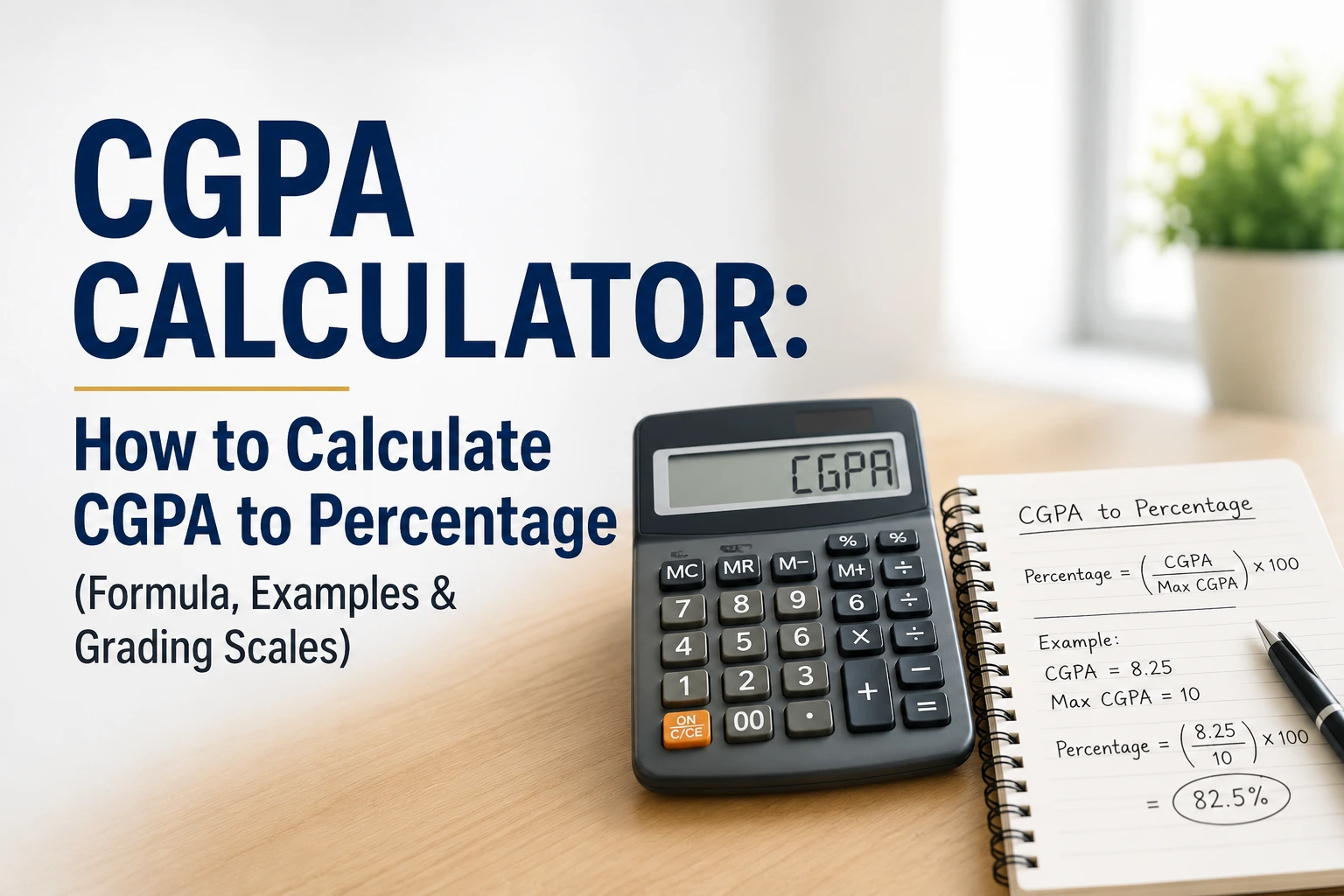
The most common method — and the one CBSE officially recommends — is a simple multiplication:
Percentage = CGPA × 9.5
Example: If your CGPA is 9.2, your percentage would be: 9.2 × 9.5 = 87.4%
Steps to Calculate CGPA to Percentage
Add up the grade points scored in all subjects.
Divide the total by the number of subjects to get your CGPA.
Multiply your CGPA by 9.5 (for CBSE-pattern institutions).
The result is your equivalent percentage.
Formula Variations by Institution
Not every university uses the CBSE 9.5 multiplier. Some common variations include:
Formula
Typically Used By
CGPA × 9.5
CBSE schools (Class 10 & 12)
CGPA × 10
Several state universities and autonomous colleges
CGPA × 9.25
Select engineering and technical universities
Because the multiplier varies by institution, it’s worth confirming which formula your university follows before submitting your percentage anywhere official. This is exactly where a CGPA to percentage calculator is useful — you can switch between formulas instantly instead of recalculating by hand.
For a quick reference without doing the math yourself:
CGPA
Percentage
10.0
95% – 100%
9.5
90.25%
9.0
85.50%
8.5
80.75%
8.0
76.00%
7.5
71.25%
7.0
66.50%
6.5
61.75%
6.0
57.00%
Understanding Related Terms: GPA and SGPA
CGPA is often confused with two related but different metrics.
What is GPA?
GPA (Grade Point Average) measures academic performance, typically over a shorter period like a single semester or term, on a scale such as 4.0, 5.0, or 10. It’s the metric most commonly used by universities abroad.
Formula: GPA (4.0 scale) = Percentage ÷ 25
What is SGPA?
SGPA (Semester Grade Point Average) reflects performance in one specific semester, calculated as a weighted average of grade points based on subject credits. CGPA, by contrast, is the average of SGPA across all semesters completed so far.
Formula: Percentage = (SGPA × 10) − 7.5
CGPA vs SGPA vs GPA — Quick Comparison
Metric
Measures
Typical Scale
CGPA
Overall performance across all semesters
0–10
SGPA
Performance in a single semester
0–10
GPA
Performance over a term (often used internationally)
Most CBSE-pattern institutions map CGPA to letter grades as follows:
CGPA Range
Grade
9.1 – 10
A1
8.1 – 9.0
A2
7.1 – 8.0
B1
6.1 – 7.0
B2
5.1 – 6.0
C1
4.1 – 5.0
C2
3.1 – 4.0
D1
How This Compares Internationally: UK Grade Classification
If you’re applying abroad, your converted percentage often needs to be mapped again to a different classification system. Here’s how it typically looks for UK universities:
Grade Class
Percentage
First Class
70% – 100%
Upper-Second (2:1)
60% – 70%
Lower-Second (2:2)
50% – 60%
Third Class
40% – 50%
Fail
Below 40%
Effective Tips to Improve Your CGPA
A higher CGPA isn’t just about last-minute exam prep — it’s built through consistent habits across the semester.
Build a realistic study timetable and stick to it rather than cramming before exams.
Prioritize concept clarity over rote memorization — CGPA-based evaluation often rewards understanding over recall.
Revise regularly instead of leaving all revision to exam week.
Practice previous years’ question papers to understand pattern and pacing.
Participate actively in class and clarify doubts early with teachers or peers.
Manage time across subjects — don’t let one weak subject pull down your overall average.
Maintain a healthy routine — adequate sleep and regular breaks measurably improve focus and retention.
Why Use an Online CGPA Calculator Instead of Manual Calculation
While understanding the formula is useful, manually calculating CGPA-to-percentage conversion — especially across multiple formula standards — is easy to get wrong. An online CGPA calculator gives you:
Instant, error-free results
The ability to switch between CGPA→Percentage and Percentage→CGPA
Support for multiple formula standards (9.5, 10, 9.25) depending on your institution
No manual recalculation needed when converting scores for multiple subjects or semesters
This becomes particularly useful when you’re applying for higher education programs, scholarships, or jobs that specify percentage requirements rather than CGPA.
Frequently Asked Questions
The most widely used formula, recommended by CBSE, is Percentage = CGPA × 9.5. However, some universities use a ×10 or ×9.25 multiplier instead, so it’s worth confirming your institution’s specific formula.
No. While CBSE officially recommends the 9.5 multiplier for Class 10 and 12, many state universities and engineering colleges use different multipliers, such as ×10. Always check with your institution before using the converted percentage for official purposes.
SGPA reflects your performance in a single semester, while CGPA is the cumulative average of your SGPA across all completed semesters. CGPA gives a more complete picture of overall academic performance.
Yes. The reverse calculation simply divides your percentage by the same multiplier used for conversion (commonly 9.5), giving you an approximate CGPA equivalent.
Because different institutions use different multipliers (9.5, 10, or 9.25). A result will differ depending on which formula standard is applied — always confirm which one matches your board or university.
Bhargavi R
HR Professional
Bhargavi Reddy is an HR professional with over 6 years of experience in IT recruitment and talent acquisition. She specializes in hiring across technologies like Java, DevOps, Python, and Data Engineering. With strong expertise in full-cycle recruitment and stakeholder management, she focuses on building high-performing teams. Currently, she works as an HR Manager driving strategic hiring initiatives.
 HOME > BLOG > Career Guidance > CGPA Calculator: How to Calculate CGPA to Percentage (Formula, Examples & Grading Scales)
 July 3, 2026
 4 min read




 ChatGPT
 Perplexity
 Claude
 Grok
Grok










 ROI Calculator