When it comes to building a career in commerce, two well-known professional qualifications are Chartered Accountancy (CA) and Company Secretary (CS). Both CA and CS are respected, lucrative, and very challenging fields, but they lead to two very different professional pathways.
A CA plays an important role in financial management, tax, and audit matters, and in ensuring businesses are healthy and compliant. Whereas a CS specialises in the policies, law, and guiding operations within corporations to ensure disciplinary actions are legal.
So, if you’re confused about which career path to take in 2026, knowing the most important differences between CA and CS can help you make a well-informed decision. In this blog, we will talk about the top 8 important differences between the CA vs CS qualifications, including eligibility, course structure, difficulty level, and job roles, to help you shortlist the best course of either CA or CS that fits your career aspirations.
Chartered Accountancy (CA) is a professional degree provided by the Institute of Chartered Accountants of India (ICAI). It trains students to become finance specialists who work with accounting, taxation, audit, and financial advice for individuals and businesses.
A CA assures the accuracy of financial records, whether taxes have been paid correctly, and that the appropriate accounting standard has been applied. CAs are often employed within corporate firms, auditing firms, banks, and government agencies. Additionally, many CA practitioners have their own practices offering advisory and audit services to clients.
The Company Secretary (CS) qualification is a professional course that is presented and regulated by the Institute of Company Secretaries of India (ICSI). The CS course provides training for individuals with the intention of becoming compliance/legal officers, focusing on corporate law, governance, and administration of a company. The Company Secretary is the keystone of the organisational compliance function – assuring compliance with the Companies Act, the SEBI, and regulations of statutory bodies.
A CS can serve as the internal advisor to the board of directors, facilitate and prepare for statutory and due diligence meetings, draft legal documents, and provide support to management in connectivity between all stakeholder communications and regulatory agencies.
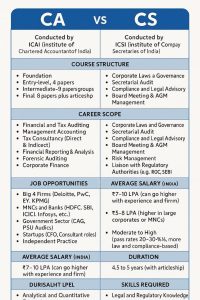
Here’s a detailed breakdown of the top eight differences between CA and CS that can help you understand which one fits your career goals better.
1. Governing Bodies
Aspect
CA
CS
Regulating Body
Institute of Chartered Accountants of India (ICAI)
Institute of Company Secretaries of India (ICSI)
Nature
Focuses on finance, taxation, and auditing
Focuses on corporate governance and legal compliance
Both ICAI and ICSI are statutory bodies established by Acts of Parliament, ensuring high educational and ethical standards. The difference between CA vs CS starts with their governing approach: finance-driven for CAs and law-oriented for CS professionals.
2. Eligibility Criteria
Aspect
CA
CS
After Class 12
Students from any stream (except fine arts) can enrol in the CA Foundation Course
Students from any stream (except fine arts) can enrol in the CS Executive Entrance Test (CSEET)
After Graduation
Graduates can skip the foundation and directly join the CA Intermediate (if eligible)
Graduates can skip CSEET and directly enrol in the CS Executive level
Both are open to commerce, science, and arts students. However, commerce students may find CA vs CS more relatable due to their academic background in accounting, economics, and business law.
3. Course Levels and Duration
Aspect
CA
CS
Levels
Foundation → Intermediate → Final
CSEET → Executive → Professional
Duration
4.5 to 5 years (including articleship)
3 to 4 years (including training)
While both are long-term commitments, CA takes slightly longer because of the mandatory 3-year articleship under a practising CA. In the CA vs CS timeline comparison, CA demands more field training, while CS emphasises theoretical learning and corporate compliance.
Company Law, Corporate Governance, Business Laws, Ethics
Nature of Study
Quantitative, Analytical, and Technical
Legal, Regulatory, and Administrative
The CA course is math-heavy, focusing on financial management and audits, while CS leans toward legal interpretation and corporate governance.
If you enjoy working with numbers and financial systems, CA may suit you better. If you’re more inclined toward law, compliance, and administration, CS could be the right choice.
5. Difficulty Level
Aspect
CA
CS
Passing Rate
Around 10–15%
Around 20–30%
Challenge Level
Very High
Moderate to High
In terms of difficulty for CA vs CS, CA is considered one of India’s toughest exams. It requires analytical problem-solving, practical exposure, and consistent dedication. CS, though challenging, is more theoretical and law-centric, making it slightly easier for those with a knack for memorisation and interpretation.
6. Career Scope and Roles
Aspect
CA
CS
Career Focus
Accounting, Auditing, Finance, Taxation
Legal Compliance, Corporate Governance, Secretarial Practice
Job Titles
Auditor, Tax Consultant, Financial Advisor, CFO
Company Secretary, Compliance Officer, Legal Advisor
Industries
Banking, Finance, Manufacturing, Government, IT
Corporate Firms, Law Firms, Stock Exchanges, PSUs
A CA can lead finance teams, manage audits, or provide consulting services. A CS handles corporate laws, secretarial duties, and governance roles. Both roles complement each other in a corporate setup, highlighting the dynamic partnership in CA vs CS career paths.
7. Salary Comparison
Level
Average CA Salary (per annum)
Average CS Salary (per annum)
Freshers
₹7–8 LPA
₹5–6 LPA
Mid-level
₹10–15 LPA
₹8–10 LPA
Senior-level
₹20–40 LPA+
₹15–25 LPA+
When it comes to CA vs CS salary, Chartered Accountants generally earn higher starting pay due to their financial expertise. However, Company Secretaries enjoy steady growth and strong corporate demand over time.
So, if your goal is higher initial pay, CA might win the CA vs CS salary comparison. But if you value long-term stability and governance authority, CS can be equally rewarding.
8. Work-Life Balance
Aspect
CA
CS
Nature of Work
High-pressure, client-based, deadline-driven
Relatively structured and stable
Flexibility
Moderate (depends on firm or practice)
Higher flexibility in corporate setups
CAs often face intense work pressure during audits and tax seasons, while CS professionals usually enjoy steadier schedules. In terms of work-life balance, CA vs CS tips in favour of CS for its predictable routine and defined compliance cycles.
CA vs CS: Which is Better for You?
CA or CS, which is better? Well, your choice between CA vs CS depends on your interests, skills, and career aspirations. In simple terms:Choose CA if you:
Enjoy working with numbers, finance, and analytics
Want to work in auditing, taxation, or financial management
Are you ready for a demanding study lifestyle
Choose CS if you:
Enjoy law, regulations, and corporate compliance
Want to work directly with board members and policy matters
Prefer a somewhat balanced work-life structure
In many businesses, CA and CS work together to complement each other’s skill sets; one manages the financial side of the business, and one ensures the business is operating within the law and its own regulations.
In fact, many ambitious people pursue both CA and CS to become dual-qualified professionals sought after in the corporate world.
Without a doubt, CA vs CS are regarded as the most respected qualifications in India, with rewarding career opportunities, solid job security, and much respect in the business community. Chartered Accountants provide financial management for companies, while Company Secretaries provide for the ethical and timely operation of those companies legally.
If you have a strong affinity for numbers, accounting, and finance, CA will be advantageous. But if law, compliance, and governance catch your attention, CS would likely make more sense.
No matter which option you pursue, success will be determined by your rigour, consistency, and professional curiosity. The business world is changing in 2026, and there is significant demand for new CA and CS professionals, making it a good time to consider your path toward a fulfilling career.
Yes, many students pursue both courses simultaneously. However, managing both requires strong time management skills and dedication due to overlapping but demanding courses.
CA is generally considered tougher because of its extensive syllabus, analytical depth, and low pass rates. CS, while challenging, is more law-oriented and comparatively easier for those interested in legal frameworks.
After completing CS, you can work as a Company Secretary, Compliance Officer, Legal Advisor, or Governance Consultant in corporate houses, law firms, or PSUs.
Both offer strong career growth, but in different areas. CA offers higher financial roles and independent practice options, while CS provides growth in corporate law and governance positions.
Get Free Upskilling Guidance
Fill in the details for a free consultation
Related Courses
Explore our programs
Advanced Programme in Financial Technologies and Financial Analytics

 December 8, 2025
 6 min read





 ChatGPT
 Perplexity
 Claude
 Grok
Grok *lakshyacommerce.com




 *linkedin.com



 ROI Calculator