
The Art of Public Speaking: 15 Tips to Improve Your Skills
 November 27, 2026
 8 min read





Table Of Content
- Why the Art of Public Speaking Matters
- Understanding Public Speaking Anxiety
- Preparation: Public Speaking Tips to Build a Strong Foundation
- Managing Public Speaking Anxiety on the Day
 Key Insights
- Public speaking is an essential skill that helps professionals communicate effectively, build credibility, influence opinions, and develop stronger relationships.
- Understanding your audience, defining a clear purpose, organising content, and practising aloud help create confident and engaging presentations.
- Public speaking anxiety can be managed through controlled breathing, positive thinking, early preparation, and visualising a successful presentation.
- Effective delivery involves using voice modulation, purposeful body language, eye contact, storytelling, and simple language to keep audiences engaged.
- In this blog, you'll learn 15 practical public speaking tips to overcome stage fear, improve communication, deliver impactful presentations, and build confidence through regular practice and feedback.
Standing before an audience can feel exciting and terrifying at the same time. Whether you are presenting a project update, delivering a toast, or leading a seminar, your ability to communicate ideas clearly can shape how others see you. The good news is that confident speaking is not a talent reserved for a lucky few. It is a learnable craft.
This blog explores the art of public speaking in a practical, step-by-step way. You will find 15 proven public speaking tips, explanations of how to manage nerves, and answers to common questions. With consistent practice, anyone can strengthen their public speaking skills and speak with greater clarity and poise.
 ChatGPT
 Perplexity
 Claude
 Grok
Why the Art of Public Speaking Matters
The art of public speaking goes far beyond standing on a stage. It influences job interviews, team meetings, sales pitches, classroom discussions, and community events. Professionals who communicate well are often seen as more capable and credible, and they are frequently trusted with leadership roles.
Strong speaking also helps you persuade, teach, and inspire. A well-structured message can change opinions, motivate teams, and build lasting relationships. Because nearly every career depends on communication, investing in your public speaking skills is one of the most valuable personal development decisions you can make.
Understanding Public Speaking Anxiety
Public speaking anxiety, also known as glossophobia, is extremely common. Surveys regularly show that many adults fear speaking in front of a group more than they fear many other situations. Symptoms include a racing heart, sweaty palms, a shaky voice, and a sudden blank mind.
These reactions are your body’s natural stress response. Your brain interprets the audience as a potential threat and releases adrenaline. The key is not to eliminate nerves entirely but to channel that energy into enthusiasm. The tips below address public speaking anxiety directly while also building the habits that lead to polished delivery.
Preparation: Public Speaking Tips to Build a Strong Foundation
Great presentations begin long before you step up to the microphone. These first five public speaking tips focus on preparation, which is the most reliable way to reduce stress and increase confidence.
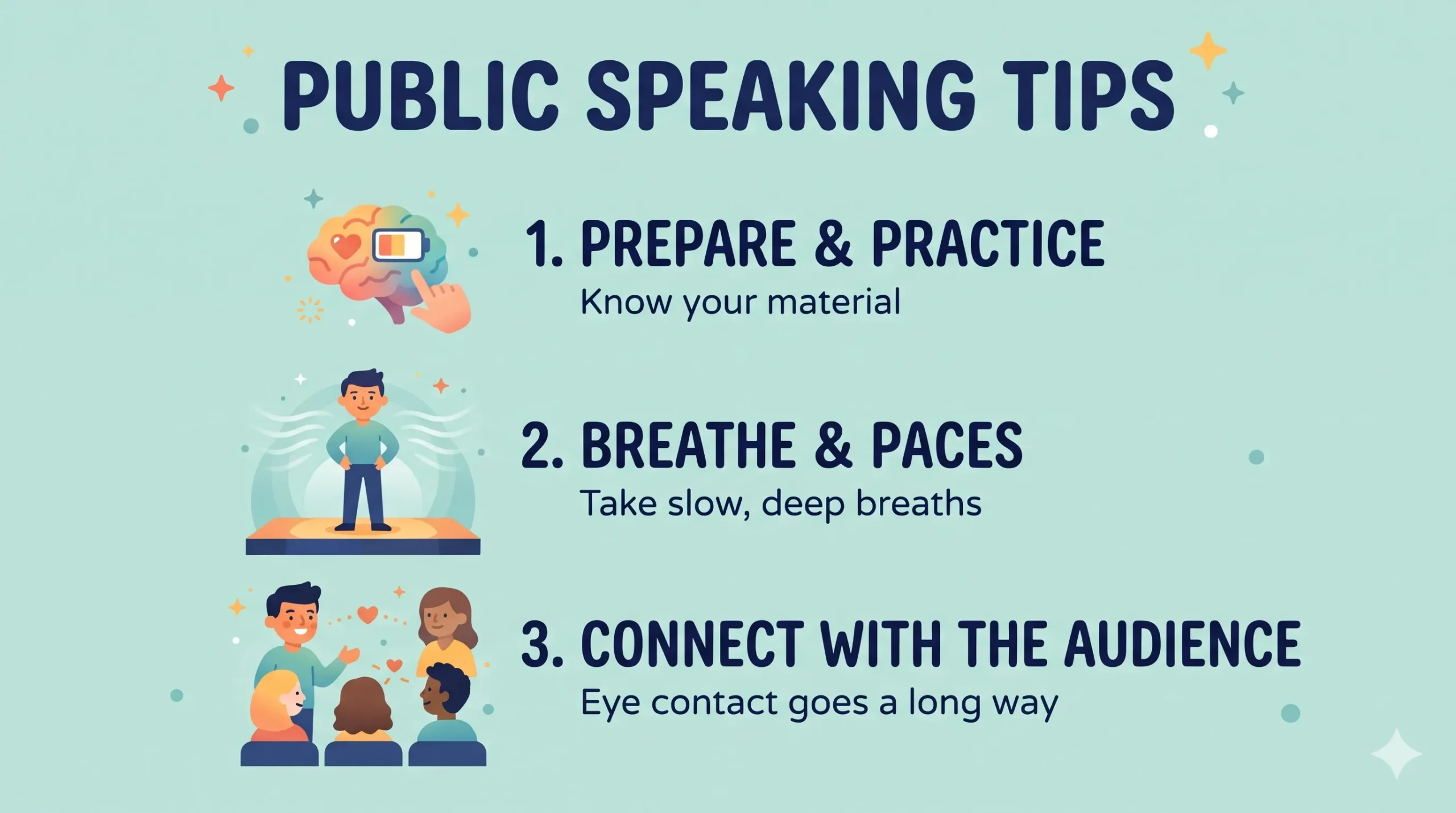
Tip 1: Know Your Audience
Every strong speech starts with understanding who will be listening. Consider their age, background, knowledge level, and expectations. Ask yourself what they care about and what they hope to gain from your talk. A message designed for beginners will differ greatly from one meant for experts. When you tailor your examples, vocabulary, and tone to your listeners, they feel respected and engaged, and your message becomes far more relevant and memorable.
Tip 2: Define a Clear Purpose
Before writing a single slide, decide what you want your audience to know, feel, or do after you finish. Your purpose might be to inform, persuade, or inspire. Write it as one simple sentence and use it as a filter for everything else. If a story, statistic, or slide does not support that purpose, remove it. A focused speech is easier to deliver and much easier for listeners to remember.
Tip 3: Organize Your Content with a Simple Structure
A clear structure keeps both you and your audience on track. The classic format of an opening, a body, and a conclusion works well in most situations. Limit your main points to three, since people recall small groups of ideas more easily. Use transitions such as “next” or “the second reason” to guide listeners. When your talk follows a logical path, you are less likely to lose your place or ramble.
Tip 4: Craft a Strong Opening
The first thirty seconds determine whether people lean in or look at their phones. Begin with a surprising fact, a short story, a thoughtful question, or a relevant quote. Avoid starting with long apologies or generic greetings. A compelling opening captures attention, builds curiosity, and gives you momentum. Practice it until you can deliver it smoothly, because a confident start often calms your nerves for the rest of the talk.
Tip 5: Practice Out Loud, Not Just in Your Head
Reading your notes silently is very different from speaking them. Rehearse aloud, ideally while standing, so you can hear your pacing and identify awkward phrases. Time yourself to ensure you stay within your limit. Practice in front of a mirror, a trusted friend, or a recording device. Repeated rehearsal builds familiarity, which makes your words flow naturally and reduces the fear of forgetting what to say.





Managing Public Speaking Anxiety on the Day
Even well-prepared speakers feel nervous. These four tips help you stay calm and composed when the moment arrives.
Tip 6: Use Controlled Breathing
Breathing is one of the fastest ways to settle your nervous system. Before you speak, inhale slowly through your nose for four counts, hold briefly, and exhale through your mouth for six counts. Repeat this several times. Deep breaths slow your heart rate and steady your voice. You can also pause and breathe quietly during your talk, which looks deliberate and confident rather than hesitant.
Tip 7: Reframe Nervous Energy as Excitement
Nervousness and excitement feel almost identical physically. Instead of telling yourself to “calm down,” try saying, “I am excited to share this.” Research in performance psychology suggests that this simple shift can improve how people handle pressure. Seeing your adrenaline as fuel rather than a threat helps you bring energy and enthusiasm to your delivery, which audiences usually enjoy.
Tip 8: Arrive Early and Get Comfortable with the Space
Unfamiliar surroundings can increase stress. Arrive early to walk around the room, test the microphone, check the projector, and stand where you will speak. Look at the seating from the speaker’s perspective. When the environment feels familiar, there are fewer surprises, and your mind can focus on your message rather than on logistics.
Tip 9: Visualize a Successful Presentation
Visualization is a technique used by athletes and performers alike. Take a few minutes beforehand to picture yourself walking up calmly, speaking clearly, and receiving positive reactions. Imagine the details, including your posture and the sound of your voice. This mental rehearsal builds a sense of familiarity and confidence, making the actual event feel less intimidating.
Delivery: Public Speaking Skills That Hold Attention
Once you begin, how you say something matters as much as what you say. These public speaking skills help you connect with listeners and keep them engaged.
Tip 10: Master Your Voice
Your voice is your primary instrument. Vary your pace, pitch, and volume to emphasize key ideas and avoid a monotone delivery. Speak slightly slower than you would in casual conversation, especially when nervous, since most people rush. Use pauses before and after important points to give them weight. A clear, steady voice signals authority and helps your audience absorb what you are saying.
Tip 11: Use Purposeful Body Language
Nonverbal communication strongly shapes how your message is received. Stand tall with your shoulders relaxed, keep your feet grounded, and use open hand gestures that match your words. Avoid pacing aimlessly, gripping the podium, or putting your hands in your pockets. Natural movement helps release tension, while confident posture projects credibility. Remember that your body should support your message, not distract from it.
Tip 12: Make Eye Contact and Connect
Eye contact builds trust and makes listeners feel included. Rather than scanning the room quickly, hold eye contact with one person for a complete thought, then move to another. In a large room, address different sections in turn. If direct eye contact feels uncomfortable at first, look at friendly faces. Connecting with individuals turns a speech into a conversation.
Tip 13: Tell Stories and Use Simple Language
People remember stories far longer than facts alone. Share a brief personal experience or a real example to illustrate your point. Choose plain, direct words over jargon, and keep sentences short. If you must use technical terms, explain them clearly. Stories create emotional connections, and simple language ensures that everyone, regardless of background, can follow and appreciate your message.
Growth: Public Speaking Tips for Long-Term Improvement
Becoming an excellent speaker is a gradual process. These final public speaking tips focus on continuous learning.
Tip 14: Seek Feedback and Review Your Performance
Honest feedback accelerates improvement. Ask a mentor, colleague, or friend to comment on your clarity, pacing, and body language. Better yet, record yourself and watch the video with a critical but kind eye. Notice filler words such as “um” and “like,” distracting habits, and moments of strong engagement. Identify one or two areas to improve each time rather than trying to fix everything at once.
Tip 15: Practice Regularly in Real Settings
Confidence grows through experience. Volunteer to speak at meetings, join a group such as Toastmasters, offer to lead a workshop, or give short talks to friends. Each opportunity builds resilience and reduces fear over time. Start with small, low-pressure settings and gradually take on larger audiences. The more often you speak, the more natural the experience becomes.
Conclusion
The art of public speaking is built on preparation, practice, and a genuine desire to serve your audience. You do not need to be perfect, and you do not need to be fearless. You simply need to understand your listeners, organize your thoughts, manage your nerves, and keep refining your delivery.
Start by choosing two or three of these public speaking tips and applying them in your next presentation. As your confidence grows, add more techniques. With patience and consistent effort, public speaking anxiety will lose its grip, and your public speaking skills will become a lasting strength in both your personal and professional life.
Frequently Asked Questions
For fast relief, use slow breathing, arrive early to become familiar with the room, and rehearse your opening until it feels automatic. Reframing nerves as excitement also helps. For lasting improvement, practice speaking in small settings regularly so your brain learns that the experience is safe.
The most essential public speaking skills include clear organization, confident vocal delivery, purposeful body language, audience awareness, and storytelling. Active listening and the ability to handle questions calmly are also valuable, because speaking is a two-way exchange of ideas.
The timeline varies from person to person. Many people notice meaningful progress within a few weeks of regular practice and feedback. Becoming a polished speaker usually takes months or years, but every presentation you deliver brings you a step closer.
Yes, notes and slides are perfectly acceptable when used wisely. Keep notes brief, using key words rather than full paragraphs, and design slides with minimal text and strong visuals. Your materials should support your message, not replace your connection with the audience.

Related Courses
Explore our programs





Find a Program made just for YOU
We'll help you find the right fit for your solution. Let's get you connected with the perfect solution.

Is Your Upskilling Effort worth it?
 ROI Calculator


Are Your Skills Meeting Job Demands?
Try our Skill Gap tool
Experience Lifelong Learning and Connect with Like-minded Professionals
Explore Jaro Connect
