The Difference Between Text Mining and Data Mining: Use Cases & Examples
J
By Dr. Sanjay Kulkarni
January 16, 20268 min read
Last updated on September 1, 2026
SHARE THIS ARTICLE
Table Of Content
Understanding Data Mining
Understanding Text Mining
Important Differences Between Text Mining and Data Mining
Real World Examples of Data Mining
We find ourselves in an analytics-driven period where institutions rely on analytics to draw meaningful patterns out of seemingly endless amounts of data. Two common techniques: text mining and data mining—are commonly confused to the extent that both involve identifying trends in patterns. Both processes involve distinct techniques and apply to distinct types of data. Being aware of what constitutes text mining versus data mining is vital to individuals seeking to better their decision-making processes in their line of endeavor. This blog will explain in detail the differences between the two techniques, in addition to citing various examples of data and text mining.
Data Mining: It refers to digging for patterns, trends, associations, or anomalies in data, which exists in many organizational spreadsheets, data warehouses, or databases. Comparing it with Text Mining, Data Mining is concerned with numeric, categorical, and transactional data.
Data mining is used by organizations to enhance decision-making, make predictions, and optimize processes. Some common methods of data mining include classification, clustering, regression, association rule mining, and anomaly mining. Get ready to witness the implementation of data mining in the banking, medical, retail, telecom, and other sectors.
Classic example: retailers analyzing customers’ purchasing histories to look for purchasing patterns. The algorithm may recommend purchases based on historical transactions—the power of data mining when working with structured data, in contrast to text data in text mining.
Understanding Text Mining
Text mining is all about extracting meaningful information from unstructured text information. Consider examples such as email communications, social media posts, customer reviews, documents, dialog messages, and articles. If you compare text mining with data mining, then basically the difference between them is that in text mining, language-based information is mainly dealt with. The technology utilizes natural language processing (NLP), machine learning algorithms, and linguistics to convert text into meaningful data. This allows us to draw insights from text related to opinions, subjects, phrases, and connections that lie within the text. The implications are endless, including but not limited to, customer service, marketing, research, and the medical industry.
One of the best ways to understand the difference between text and data mining would be to consider the example of online review sentiment analysis. It’s one of the easiest ways to understand the application of text mining because, in this case, corporations are able to determine the positive or negative opinions of customers.
Important Differences Between Text Mining and Data Mining
To understand the contrast between text mining and data mining, it is important to explore the key differences between the two. Key differentiators include the type of data on which the analysis is performed, where data mining operates on data, and text mining operates on text.The other significant divergence is found within their methodologies. Data mining uses statistical models and algorithmic processes typically used on numerical data. Text mining, on the other hand, uses NLP algorithms to understand meaning, semantics, and syntax. Each has strengths and numerous applications.
Result interpretation is another area where variations occur. Data Mining always outputs some mathematical patterns, clusters, or predictive models. For instance, in Text Mining, the output takes the form of themes, opinion scores, keyword frequencies, or topic distributions. Variations here again confirm that Text Mining is not a rival to Data Mining.
Real World Examples of Data Mining
To better explain the concept of data mining, here are some practical examples of data mining in action. Data Mining in Banking: Banks use data mining techniques to identify fraud in transactions. Computers analyze transaction patterns to pinpoint transactions that seem fraudulent in nature. This is another iconic example in risk management analysis.In healthcare, data mining assists in predicting outbreaks of diseases and patient readmission ratios. Hospitals get to explore patient files and medical histories of patients, and hence, healthcare analytics provides one of the best environments in which to consider data mining examples. In text mining vs data mining, medical files would belong to text mining.
Data mining helps retailers to depend on inventory planning as well. They analyze their previous sales and seasonal trends to predict the demand correctly. Such structured data points out how data mining improves efficiency.
Text Mining in the Real World
Equally important is the application of text mining. Social sites are being monitored by companies to understand how their brand is perceived. The most popular application of text mining is sentiment analysis on Tweets.In the customer support context, organizations look at customer support messages to find repeating issues that can be identified by text mining. The text mining examples illustrate how businesses can enhance products as well as reduce the costs associated with customer support. This is opposite to data mining, as the information involved is unstructured.
Legal and compliance departments can also apply text mining. For instance, reviewing agreements and legal papers allows organizations to find areas that pose threats while ensuring compliance. This particular example demonstrates that text mining can uncover information that is concealed within a large collection of papers.
In comparing text mining to data mining, it is helpful to lay out the techniques. In data mining, the techniques include decision trees, k-means clustering, linear regression, and association rule mining. These techniques excel on relational data and frequently appear in examples of data mining.Text mining utilizes techniques such as tokenization, stemming, lemmatization, named entity recognition, and topic modeling. Each of these text mining techniques is used in a number of text mining examples.
Machine learning is common in both areas, but feature engineering is quite different due to the types of data.
Use Cases: When to Use Data Mining
It is well suited to structured data—transaction logs, sensor data, and customer info, and so on. Traditional winning use cases include predictive modeling, forecasting, and optimization. It excels at number pattern detection, performance measurement, and actionable insights. In terms of comparison when it comes to text mining vs. data mining, if you require concrete result outcomes with a good deal of precision, then data mining is where you should go.
Fraud detection, recommendation engines, and churn prediction are all excellent examples of what data mining can do for business intelligence.
Use Cases: When to Use Text Mining
Text mining is most effectively performed on large piles of text that are unstructured. Typical applications involve handling customer feedback, document classification, and sentiment analysis.Enterprises rely on the use of text mining to understand opinions, emotions, as well as themes that appear repeatedly. In the debate between the use of text versus data mining, one can clearly note that the strengths of text mining arise from its ability to provide qualitative findings that can be missed by numbers.
Sectors that rely on text mining extensively include media, legal, healthcare, or marketing.
From a business perspective, text mining and data mining aren’t about picking one over the other. Organizations usually combine both methods to get a complete view of their data.For instance, a company might look at sales figures using data mining while also checking customer reviews through text mining. This combined approach leads to better strategic decisions.
Businesses that recognize the connection between text mining and data mining can uncover deeper insights and gain a competitive edge.
Challenges in Data Mining and Text Mining
Both methods have their own challenges. In data mining, data quality and missing values can impact accuracy. Large datasets also demand significant computing power.In text mining, issues like language ambiguity, sarcasm, and context interpretation make it more complex than traditional data mining.
When we compare text mining and data mining, it’s clear that each requires specific tools and expertise to tackle these challenges effectively.
Tools Used for Text Mining and Data Mining
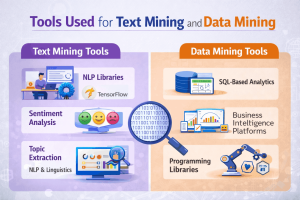
Several tools support data mining, including Python libraries, SQL-based analytics, and business intelligence platforms. These tools help process large organized datasets effectively.For text mining, common tools include NLP libraries, sentiment analysis engines, and machine learning frameworks. These tools aid in text preprocessing and analysis.
Choosing the right tools depends on whether your focus is text mining, data mining, or a mix of both.
Role of Text Mining and Data Mining in Modern Decision-Making
In modern times, making organizational decisions has increasingly become dependent on information generated through analytics, making both text and data mining extremely useful. To help an organization decide what tool to use, it is essential for them to understand both text and data mining. While data is structural, like the number of sales, accounts, and demographics of customers, it is analyzed through data mining. When it comes to documents, reviews, or emails, they must be mined through text mining techniques.
In many cases, businesses have combined the concepts of data mining and text mining to take a full understanding of business activity. A business example could be an e-commerce site deciding to utilize the capabilities of data mining to understand the buying patterns and sales of its items while employing the tool of text mining to understand customer feedback to determine customer satisfaction.
In the comparison between text mining and data mining, it’s apparent that each method is not adequate without the other. Organizations that implement the two methodologies of text mining and data mining together have the best opportunity to identify opportunities and risks and remain equipped to change with the dynamic marketplace. In the era of more data being collected, these two methodologies will remain core to smart decision-making.
Future Trends for Text Mining and Data Mining
Looking ahead, analytics is expected to combine the fields of text and data mining as AI becomes ever smarter. Companies are expected to integrate both processes into one analytics platform. The latest technologies in AI are improving the accuracy of text mining, and we are better able to understand language. However, automation is making data mining more efficient by reducing the need for more hands-on tasks.
Soon, organizations adopting both these strategies will reap richer dividends in their data ecosystem.
Conclusion
Understanding the distinction between text mining and data mining is important in today’s data-centric world. Data mining involves analytics that are purely data-related. Text mining, on the other hand, relies on text. From this comparison, these applications serve distinct yet complementary functions.
Starting from real-life data mining tasks such as fraud analysis and sales prediction, to text mining tasks like sentiment analysis and document categorization, each has its own set of strengths. The organizations that implement the capabilities of both will make better decisions and innovate.
In conclusion, knowing both Text Mining and Data Mining can help businesses translate raw data, be it numbers or texts, into useful intelligence.
Frequently Asked Questions
Text mining and data mining are two kinds of analysis techniques adopted to extract information from various types of data. The focus of text mining lies on unstructured data, whereas data mining deals with structured data, which also denotes the fundamental difference between the two. Examples of data mining applications involve analysis of sales trends, while examples of text mining involve sentiment analysis and document categorization.
Text mining is the process of extracting useful information from unstructured text data through analytical and statistical techniques. Examples include sentiment analysis of customer reviews and topic detection in social media posts.
In fact, data mining is a very lucrative career path due to the increasing trend towards data-driven decision-making. Data miners involved in data mining tasks such as predictive analytics and fraud analysis are very much sought after. In relation to text mining and data mining, the career path of data mining focuses more on statistics, machine learning, and structured data.
Text Mining and NLP: Though both terms seem synonymous, they are not. NLP is utilized by text mining. Some applications involving NLP include tokenization and sentiment analysis. When we relate text mining to data mining, NLP helps machines talk the human language, whereas data mining focuses on data expressed in numbers.
Dr. Sanjay Kulkarni
Data & AI Transformation Leader
Dr. Sanjay Kulkarni is a Data & AI Transformation Leader with over 25 years of industry experience. He helps organizations adopt data-driven and responsible AI practices through strategic guidance and education. With experience across startups and global enterprises, he bridges the gap between theory and real-world application. His work empowers teams to innovate and thrive in AI-driven environments.
Get Free Upskilling Guidance
Fill in the details for a free consultation
Related Courses
Explore our programs
Advanced Data Science Certificate Programme
Rotman School of Management & IITM Pravartak Technology Innovation Hub of IIT Madras
 HOME > BLOG > Data Science and BI Analytics > The Difference Between Text Mining and Data Mining: Use Cases & Examples
 January 16, 2026
 8 min read




 ChatGPT
 Perplexity
 Claude
 Grok
Grok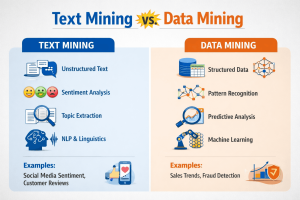











 ROI Calculator