NSE and BSE: Understanding India's Major Stock Exchanges
SEBI: Its Role and Importance in the Indian Stock Market
Key Insights
Investing in the share market allows individuals to participate in company ownership and potentially earn returns through capital gains and dividends.
Beginners should set clear financial goals, build an emergency fund, open an account with a regulated broker, and start investing with a small amount.
Index funds, ETFs, and mutual funds offer different investment options, while regular investing and portfolio reviews help maintain a disciplined approach.
Share market risks include market fluctuations, company-specific issues, inflation, liquidity challenges, and emotional decisions. Diversification, long-term investing, low costs, and avoiding borrowed money can help manage these risks.
In this blog, you'll learn how to invest in the share market, build investment knowledge, choose suitable investment options, understand share market risks, and develop responsible investing habits.
Many people want to grow their savings but feel unsure where to begin. The share market can look complicated, with fast-moving prices, unfamiliar terms, and constant news headlines. Some beginners worry they need a large amount of money or advanced financial knowledge before they can start. In reality, the basics are simple enough for anyone to learn, and a thoughtful, patient approach often works better than quick guesses.
Investing in shares allows your money to grow over time, helps you stay ahead of rising prices, and can support important goals such as retirement, education, or buying a home. This blog explains how to invest in the share market step by step, shows practical ways on how to learn share market concepts with confidence, and helps you understand share market risk before you put any money in.
Stocks, also known as shares or equity, represent ownership in a company. When you purchase a company’s shares, you become a shareholder and own a small portion of that business. Companies issue shares to raise capital for business expansion, operations, research, and other activities.
What Is the Share Market?
The share market, also called the stock market, is a platform where buyers and sellers trade shares of publicly listed companies. A share represents a small piece of ownership in a business. When you buy a share, you become a part-owner, and your investment can grow if the company performs well.
Investors usually earn in two ways:
Capital gains: You sell a share at a higher price than you paid.
Dividends: Some companies share part of their profits with shareholders on a regular basis.
Because prices change daily, shares carry both opportunity and uncertainty. That is why preparation matters.
For beginners, it is important to understand the two main markets in which shares are bought and sold.
Type of market
Meaning
Example
Primary market
Companies issue new shares to investors to raise capital.
Investing in an Initial Public Offering (IPO).
Secondary market
Investors buy and sell existing shares through stock exchanges.
Buying listed company shares through a trading app.
Investing in stocks requires research, patience, and an understanding of risk. Beginners should learn how the market works, understand a company’s financial performance, and consider their financial goals before investing.
NSE and BSE: Understanding India's Major Stock Exchanges
India has two major stock exchanges, the National Stock Exchange (NSE) and the Bombay Stock Exchange (BSE). Both provide an organised platform for buying and selling listed securities, helping investors trade shares and companies access capital through the securities market.
National Stock Exchange (NSE)
The National Stock Exchange of India (NSE) is one of India’s leading stock exchanges. It provides an electronic trading platform for various financial instruments, including equity shares, bonds, exchange-traded funds (ETFs), and derivatives. Its benchmark index, the Nifty 50, tracks the performance of 50 major companies listed on the exchange.
NSE’s electronic trading system helps investors place orders through registered stockbrokers and supports transparent price discovery. The exchange also provides market information that investors can use to understand trading activity and market movements.
Bombay Stock Exchange (BSE)
The Bombay Stock Exchange (BSE) is one of Asia’s oldest stock exchanges. It offers a platform for trading listed securities and supports the process through which companies raise capital and investors buy or sell financial instruments. Its widely followed benchmark index, the S&P BSE Sensex, tracks 30 major companies selected from the BSE-listed universe.
SEBI: Its Role and Importance in the Indian Stock Market
The Securities and Exchange Board of India (SEBI) is the primary regulator of India’s securities market. Established under the SEBI Act, 1992, it works to protect investors, promote the development of the securities market, and regulate its activities.
SEBI oversees various market participants, including stockbrokers, investment advisers, mutual funds, and other registered intermediaries. Its regulatory framework aims to encourage fair practices, improve transparency, and address misconduct in the securities market.
Why Is SEBI Important for Beginners?
SEBI’s regulatory framework helps create a more transparent and accountable investment environment. Before opening a trading account, beginners should verify whether their broker is registered with SEBI and check the relevant exchange membership details.
Investors should also avoid acting on unverified stock tips, guaranteed-return promises, or unsolicited investment messages. They can access educational material and investor grievance resources through the official SEBI Investor website.
What Is a Demat Account and Why Is It Important for Share Market Trading?
A Demat account, short for dematerialized account, is an account used to hold shares and other eligible securities in electronic form. It eliminates the need to maintain physical share certificates and allows investors to hold their investments digitally.
In India, Demat accounts are maintained through Depository Participants (DPs), which provide access to the services of the two recognized securities depositories, the National Securities Depository Limited (NSDL) and the Central Depository Services (India) Limited (CDSL).
Difference Between a Demat Account and a Trading Account
Although these accounts are often opened together, they serve different purposes.
Basis
Demat account
Trading account
Main purpose
Holds securities electronically.
Places buy and sell orders in the market.
Opened with
A Depository Participant.
A registered stockbroker.
Function
Maintains your securities holdings.
Facilitates transactions on the stock exchange.
Example
Holds the shares you purchase.
Enables you to place an order to purchase those shares.
A bank account is also required for funding transactions and receiving payments. Therefore, investors generally need a bank account, a trading account, and a Demat account to trade in listed shares.
Free Courses
Finance for All – Free Finance Certification Course
Common Stock Market Terms Every Beginner Should Know
Understanding stock market terminology can help beginners interpret market news, understand trading platforms, and make informed investment decisions. The following table covers some of the most commonly used terms in the Indian share market.
Stock market term
Meaning
Stock or share
A unit representing partial ownership in a company.
Stock exchange
A regulated marketplace where listed securities are bought and sold.
IPO (Initial Public Offering)
The process through which a company offers its shares to the public for the first time.
Bull market
A market phase characterized by generally rising prices and positive investor sentiment.
Bear market
A market phase characterized by generally falling prices and negative investor sentiment.
Sensex
The benchmark index tracking 30 selected companies listed on the BSE.
Nifty 50
The benchmark index tracking 50 major companies listed on the NSE.
Market capitalisation
The total market value of a company’s outstanding shares, calculated by multiplying the share price by the number of outstanding shares.
Dividend
A portion of a company’s profits or reserves distributed to eligible shareholders when declared.
Portfolio
The collection of investments held by an individual or institution.
Brokerage
The fee charged by a broker for facilitating eligible transactions.
Liquidity
The ease with which an asset can be bought or sold without significantly affecting its price.
Volatility
The degree to which an asset’s price fluctuates over time.
Bid price
The price a buyer is willing to pay for a security.
Ask price
The price at which a seller is willing to sell a security.
Trading volume
The number of shares or contracts traded during a specified period.
Demat account
An account that holds securities electronically.
Trading account
An account used to place buy and sell orders through a stockbroker.
Stop-loss order
An order or order instruction designed to help limit losses by triggering a sale or purchase when a specified price condition is met. Execution is not guaranteed at the trigger price.
Intraday trading
Buying and selling securities within the same trading day.
Delivery trading
Buying securities and holding them beyond the trading day, with settlement and delivery according to applicable rules.
Mutual fund
An investment vehicle that pools money from investors and invests it according to a stated investment objective.
ETF (Exchange-Traded Fund)
An investment fund whose units trade on a stock exchange.
SIP (Systematic Investment Plan)
A method of investing a fixed amount at regular intervals in a mutual fund scheme.
Capital gain
Profit earned when an asset is sold for more than its purchase cost, subject to applicable calculations and tax rules.
Learning these terms helps beginners understand investment products and trading activity more clearly. However, knowing the terminology alone is not enough. Investors should also understand the risks, charges, and features of each financial product before investing.
How to Invest in Share Market: Step-by-Step Process
Here is a clear path for beginners who want to know how to invest in share market responsibly.
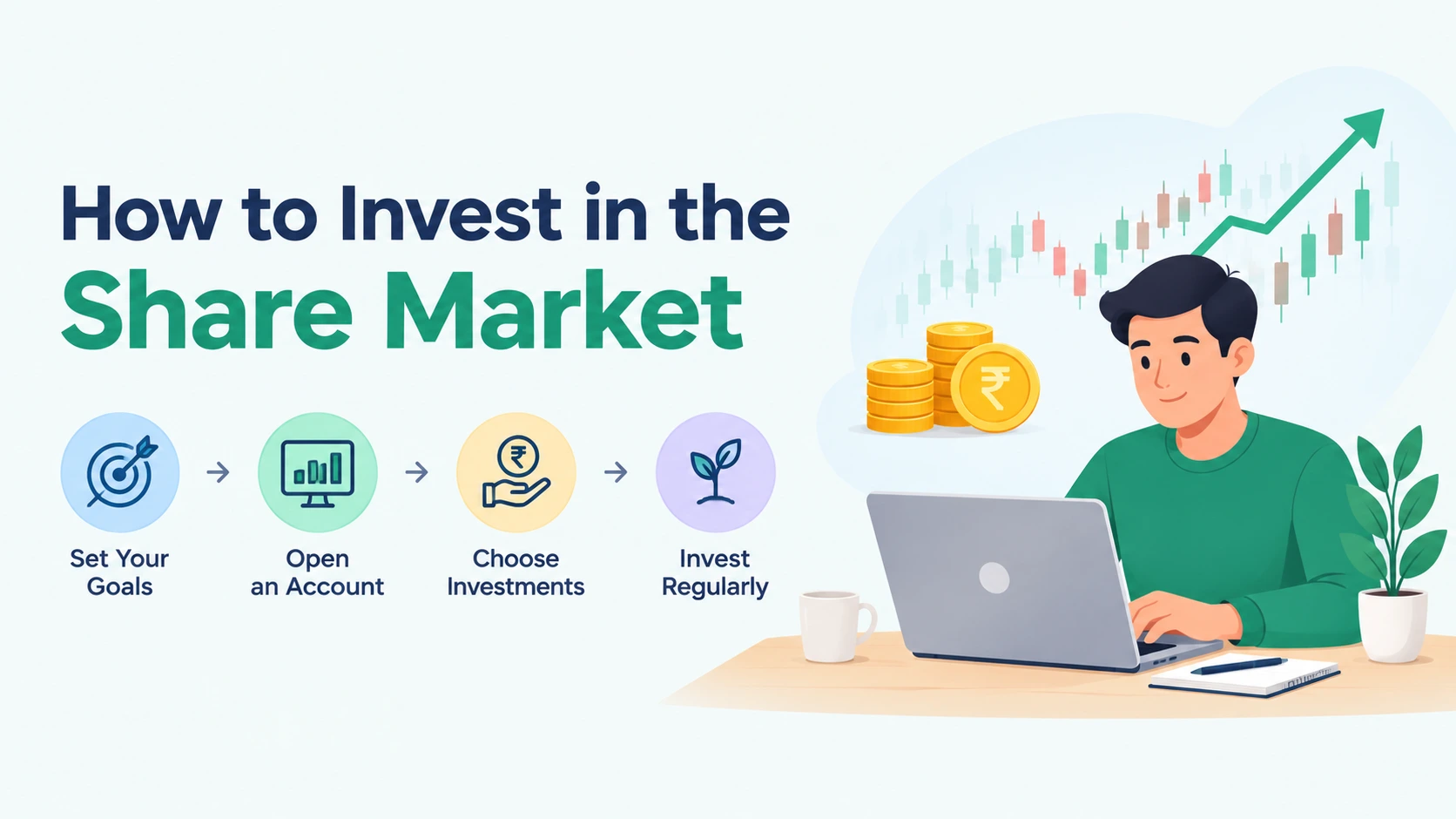
Step 1: Set clear financial goals
Decide why you are investing. Your goal might be retirement, a home down payment, or your child’s education. Your time horizon matters most. Money needed in one or two years should generally not be placed in shares, while money you will not need for five to ten years or longer can handle more ups and downs.
Step 2: Build an emergency fund first
Before investing, keep three to six months of living expenses in a safe, easily accessible account. This cushion prevents you from selling investments at a bad time to cover unexpected bills.
Step 3: Open the required accounts
To buy shares, you need an account with a registered broker or brokerage firm. Depending on your country, you may also need a linked bank account and a securities account to hold your shares electronically. Choose a regulated broker, compare fees and platform ease, and complete the identity verification process. Always confirm that the firm is registered with your national market regulator.
Step 4: Start with a small amount
You do not need a large sum to begin. Many platforms allow you to buy a single share or a fractional share. Starting small lets you learn how the market behaves while keeping your potential loss limited.
Step 5: Choose what to invest in
Beginners generally have three main choices:
Individual stocks: You pick specific companies. This requires research and carries higher risk.
Index funds and ETFs: These funds hold many stocks at once and track a market index. They offer instant diversification and low costs, which is why many educators recommend them to beginners.
Mutual funds: Professional managers select the investments for you, usually for a management fee.
Step 6: Invest regularly
Instead of trying to find the perfect moment to buy, consider investing a fixed amount every month. This habit, often called dollar-cost averaging, spreads your purchases over time. You buy more shares when prices are low and fewer when they are high, which reduces the impact of market swings.
Step 7: Review, but do not overreact
Check your portfolio periodically, perhaps every quarter, to make sure it still matches your goals. Daily price movements are normal and should not push you into panic decisions.
Popular Investment Apps in India for Beginners
Investment appsallow users to access financial markets, explore investment products, monitor portfolios, and place transactions through digital platforms. Depending on the provider, an app may support stock trading, mutual fund investments, IPO applications, ETFs, or other financial services.
Some popular platforms used by investors in India include the following.
Investment app or platform
General use
Groww
Offers access to investments such as stocks and mutual funds, subject to available services.
Zerodha Kite
A trading platform used to place orders and monitor market activity.
Upstox
Provides access to stock market trading and other investment services.
Angel One
Offers trading and investment services through its digital platform.
Dhan
Provides trading tools and market access for investors and traders.
INDmoney
Provides investment tracking and access to selected investment products.
Paytm Money
Offers access to selected investment and market-related services.
The features, charges, eligibility requirements, and supported products can change. This list is intended for awareness and is not a ranking or investment recommendation.
How to Learn Share Market: Practical Ways to Build Knowledge
Understanding the market is the best protection for your money. If you are wondering how to learn share market concepts without feeling overwhelmed, try these approaches.
Start with the basics. Learn key terms such as shares, index, dividend, market capitalization, price-to-earnings ratio, bull market, and bear market. A simple glossary on your broker’s website or a regulator’s investor education page is a good start.
Read reliable books. Classic titles such as The Intelligent Investor by Benjamin Graham and A Random Walk Down Wall Street by Burton Malkiel explain long-term investing in clear language.
Take structured courses. Many universities andlearning platforms offer beginner-friendly courses on investing and personal finance, and several are free or low-cost. Official investor education programs from market regulators and exchanges are also trustworthy.
Follow credible news sources. Read business news and company reports regularly to understand how economic events, interest rates, and earnings affect prices.
Practice with a simulator. Virtual trading apps let you buy and sell shares with pretend money. This helps you understand how orders work and how prices move without risking real savings.
Learn to read basic company information. Look at revenue growth, profit, debt, and how long the company has been in business. You do not need to be an expert, but you should understand what you own.
Be careful with tips. Social media and messaging groups are full of “guaranteed returns” and “hot stock” claims. No one can guarantee profits in the share market. Verify any suggestion through official filings and independent sources.
Every investment carries uncertainty, and knowing the types of share market risk helps you manage it.
Market risk: The whole market can fall because of economic slowdowns, political events, or global shocks. This affects almost every stock.
Company-specific risk: A single business may struggle because of poor management, falling sales, or legal trouble.
Inflation and interest rate risk: Rising interest rates and prices can reduce company profits and affect valuations.
Liquidity risk: Some shares trade rarely, which can make them hard to sell quickly at a fair price.
Emotional risk: Fear and greed often cause investors to buy at peaks and sell at lows. Many losses come from behavior, not from the market itself.
How to reduce share market risk
You cannot remove risk completely, but you can control it:
Diversify: Spread your money across different companies, sectors, and asset types, such as bonds, so one poor performer does not damage your whole portfolio.
Invest for the long term: Historically, markets have recovered from downturns over long periods, although past performance does not guarantee future results.
Invest only what you can afford: Never use money needed for rent, food, or debt payments.
Avoid borrowing to invest: Leverage can magnify losses as well as gains.
Keep costs low: High fees and frequenttradingeat into returns.
Know your risk tolerance: If a 20 percent drop would keep you awake at night, choose a more conservative mix.
Conclusion
Learning how to invest in share market is a gradual process, and every successful investor started as a beginner. Begin by setting clearfinancial goals, building an emergency fund, and opening an account with a regulated broker. Start with a small amount, invest regularly, and choose diversified options such as index funds if you are unsure where to begin. Keep growing your knowledge through trusted books, courses, and simulators, so you understand how to learn share market basics with confidence. Most importantly, take share market risk seriously by diversifying, avoiding emotional decisions, and thinking long-term. The market rewards patience far more often than haste. With steady habits, realistic expectations, and a willingness to keep learning, you can build wealth over time.
Frequently Asked Questions
There is no fixed minimum. Many brokers allow you to start with a small amount, and some offer fractional shares or low-cost funds. What matters most is investing money you can afford to leave untouched for several years.
The share market is not risk-free, and prices can fall as well as rise. Beginners can lower risk by choosing diversified index funds, investing regularly, and staying invested for the long term.
Index funds and ETFs are often considered a simpler starting point because they spread your money across many companies at low cost. Individual stocks can offer higher rewards but require more research and carry higher risk.
Yes. Free regulator resources, books, online courses, and virtual trading simulators can teach you the fundamentals. Start with the basics, practice without real money, and move to real investing gradually.
Arif Siddiqui
Head of Accounting and Treasury
Arif Siddiqui is a finance leader specializing in accounting, treasury, and financial strategy. As Head of Finance at Generali Employee Benefits, he brings extensive experience in managing global financial operations. He is known for driving financial efficiency and governance across organizations. His leadership supports sustainable business growth and financial excellence.
Get Free Upskilling Guidance
Fill in the details for a free consultation
Related Courses
Explore our programs
Professional Certificate Programme in Investment Banking, Risk & Capital Markets

 October 28, 2026
 12 min read




 Key Insights
 ChatGPT
 Perplexity
 Claude
 Grok











 ROI Calculator