
How to Crack RBI Grade B Exam: Tips, Strategy, and Resources
 December 19, 2025
 9 min read





Table Of Content
- How To Start Preparation For RBI Grade B
- RBI Grade B Preparation Tips for Interview
- Best Online Platform for RBI Grade B Preparation
- The Bottom Line
Cracking the RBI Grade B exam is possibly one of the most satisfying accomplishments for aspirants who have always wanted to get into premium government jobs associated with formulating India's monetary policies. Just imagine, you become an RBI Grade B Officer, directly impacting the financial stability of India, a respectful experience, and the attractive RBI Grade B salary with various perks. Exciting, right?
But let’s be slightly more realistic; the journey to crack this examination could easily become overwhelming. The syllabus is colossal, there are multiple phases of examination, descriptive answers will test your skill acumen, and there will even be an interview round that will test your knowledge and attitude. Do not worry, start well, and you can even relieve panic.
Whether you are a beginner or a subject expert, this overall easy to understand complete guide will help you to manifest how exactly you can crack the RBI Grade B exam along the way with appropriate tips and strategies and resources. Let's get started!
 ChatGPT
 Perplexity
 Claude
 Grok
GrokHow To Start Preparation For RBI Grade B
 *edurev.in
If you are just beginning your preparation, don’t feel bad: even some of the most successful aspirants were once completely new. The actual distinction between “those that pass the exam” and “those that do not pass” is based on strategy as opposed to aptitude. You will not study for 12 hours every day. You do not need to memorise each newspaper. What you will need is: a simple roadmap, solidified basics, and consistency.
Think about your actual preparation experience: it is like a long train ride. You cannot instantaneously jump to your destination, however, you will reach your destination if you ride the train as directed. Before diving headfirst into study books and materials, create clarity: what are you preparing for? How can you expect the test will ask you to navigate the exam? In reality, how much time can you dedicate?
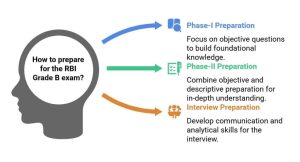
The smartest way to start is to break your preparation into six segments:
1. Know the Syllabus & Exam Pattern First
Visualise entering a battle without knowledge of the weapons and the enemy. That is precisely what individuals endure when they start preparing without first examining the RBI Grade B syllabus. The pattern of the examinations and the syllabus are your best friend – telling you where to spend time, what to skip, and how to study smarter, not harder.
This is how the RBI grade b syllabus is structured:
Phase 1
- One objective paper, containing 200 marks
- Time: 120 minutes
- Sections: General Awareness, Quantitative Aptitude, Reasoning, English
Many students wrongly believe the General Awareness section is less important, because it is a short portion of the exam. Most of the time, this is the decider of the ranking!
Phase 2
This section includes three papers, including both objective and descriptive answers, for 100 marks a piece:
- Economic and Social Issues
- English (Writing Skills)
- Finance/Management
Although descriptive answers are not just a memory task, it examines your capacity to understand current economic events and policies – and the ability to examine and structure an answer.
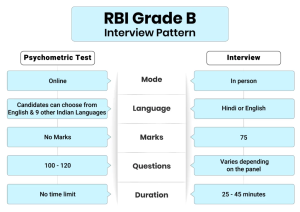
Phase 3: Interview
In this part, the examination does not have a time limit; it examines your personality, sense of control/confidence, understanding of current reforms in India, and appreciation of the job profile.
An action that you can take right now, is to download the official notification, and read the total syllabus for the RBI Grade B. You can print it out and/or sign up in a visible area on your study desk for constantly/tab pursuant.
2. Work on Your Basics
The RBI exam focuses on concepts rather than memorizing the facts, so if your fundamentals are weak, cramming in hours of study every day won’t help. Instead, prioritize your fundamental concepts in:
- Economics (Micro + Macro)
- Indian Economy
- Finance Fundamentals
- Principles of Management
- Current Affairs (only after fundamentals)
How Do You Build Basics?
- Read NCERTs (Economics 9-12) — simple and effective.
- Read a basic Indian Economy book (Ramesh Singh, NCERT compiled), then repeat the process with a second.
- Familiarize yourself with banking terms using RBI official website handouts.
- Watch short videos on economic concepts so you have a visual depiction of the ideas.
Why Do Basics Matter?
- They help you write high-quality, descriptive answers.
- They help you digest current affairs once your theory has been established.
- Concepts are more easily remembered, and your confidence when solving analytical questions will soar.
3. Find Your Strengths and Weaknesses
Everyone has unique qualities. Some are good with numbers. Some are good with writing. Some are better than others at memorizing current events. The catch? Most people will look at someone else’s study plan rather than nail down their own learning style.
How can I figure this out?
- Take a diagnostic mock test.
- Tackle questions from previous years (PYQ’s)
- While you take the tests or solve the PYQ’s—set a timer and see how fast you can go.
Once you’ve evaluated your difficulties, recognise these are the two different categories of subjects:
- Strong sections: Maintain the strong sections with weekly revision.
- Weak sections: Add more daily dedicated time and practice with a lot of focus.
FYI: Don’t run from your weak subjects. We assure you that you will thank yourself later. Introducing yourself early, did we mention this is personalized to you?
4. Practice Mock Tests
Mock tests are not simply for practice; they serve as assessments of your reality. You’re able to feel exam pressure, see if you’re abiding by timing rules, uncover common mistakes, and see if you improve throughout the mock.
Benefits to Taking a Mock Test
- Improve your speed in sections
- Minimise careless errors
- Prepare you for trick questions
- Build confidence
- Improve your ability to think under pressure
Your Smart Mock Test Strategy
- Stage
- Frequency
- Beginning
- 1 mock test each week
- Intermediate
- 2 mock tests each week
- Last 3 months
- 3-4 mock tests each week
FYI: This is the most important-the mock tests help you only if you analyze them–more time should be spent analyzing your errors than taking the mock tests. There should be an error notebook and that should be reviewed weekly.
5. Brush Up on Current Affairs
Current Affairs is the heart of the RBI Grade B exam, especially in Phase 2. But here’s the big mistake that aspiring candidates make and that is starting with current affairs on Day 1. This is, of course, not smart at all. If your basics are weak, you will not be able to understand economic news appropriately.
Recommended Sources:
- Spotlight
- PIB Current Affairs
- Economic Survey
- Union Budget
- Finance Current Affairs
When do you Start Current Affairs?
- When you have finished 50% of the syllabus
- Do not start on Day One
- Weekly Strategy
- Maintain a notebook of current affairs articles.
- Focus on news that has relevance to banking and finance, mainly within an economic context.
- Have revision through monthly compendiums.
- Practice writing descriptive answers relevant to economic news from recent developments.
6. Create a Study Timeline
Your preparation is not complete without a timeline. Studying randomly will only lead to confusion and burnout. A timeline can ensure balance, progression and consistency in your preparation.
Some steps in creating a timeline are:
- Choose the hours of study in a day (minimum 4-6 hours in one day).
- Arrange Blocks of time for each purpose.
- Designate time for Building concepts, Current affairs , Mock tests, Descriptive practice
RBI Grade B Preparation Tips for Interview
 *edutap.in
Completing phase 1 and phase 2 is an accomplishment. But the interview is where the final story is written. This is when the panel will assess your character, views and values, communication, financial acumen, and authenticity as a public servant.
Important Advice for Interview Preparation
- Understand your resume: Be knowledgeable about every point in your resume. For example, the panel loves to ask questions related to your qualifications, hobbies and job experience (if relevant), and the big thing is to be honest — you never want to lie, be boastful, or exaggerate.
- Understand everything about RBI: You should at minimum know, RBI’s history, Functions and departments, Monetary policy, and The role of an RBI Grade B officer.
- Research Current Affairs in Detail: Learn about Inflation rate trends, connections with commodity prices, Digital banking interests, The monetary policies of the RBI, Union Budget & Economic Survey, and NPA, banking reforms and GDP trends.
- Prepare Documents: Having document issues could eliminate you prior to the start of the interview. Make sure everything is organized 2–3 days in advance.
- Work on your communications skills: To improve your communication skills consider a mock interview and remember that your posture, clarity, and eye contact should always be present.




Best Online Platform for RBI Grade B Preparation
If you’re preparing for the RBI Grade B exam and feeling overwhelmed without the right support, it is especially challenging when you are managing multiple things such as writing descriptive pieces, conceptualizing finance-related concepts, and following up with current affairs on a continuous basis.
- In these cases, the very first thing that should be taken into account is to explore a genuine online platform to help with one of the smartest decisions you can make to streamline your preparation.
- The learning platform provides well-researched study material, classes instructed by professors, mock tests, and practice modules that are modeled closely on the format used during the actual examination.
- One of the much sought after offerings provided to learners, is the GA + ESI + FM MCQ Batch for RBI Grade B 2025 (Phase 1 & 2). In the case of objective performance, especially scoring high attempting General Awareness, Economics and Finance MCQs, this specific batch attempts to provide you with the greatest opportunity to practice MCQs with expert explanations.
- The process aims to develop your conceptual understanding while also increasing your accuracy and speed at the time of the examination.
The Bottom Line
Getting through the RBI Grade B exam is demanding, but so is anything worth achieving. If you have clarity, reason, and persistence, you will fulfill this desire. As we said above, you do not need to study for 12 hours. You do not need to follow someone else’s routine. You just need disciplined and continuous effort, and smart studying in line with the RBI Grade B syllabus.
If you believe in yourself, you can stick to your plan, revise every week, and keep upgrading your knowledge in line with your pace. Becoming an RBI Grade B officer, getting your RBI Grade B salary, and working in the center of India’s economic system is around the corner.
To begin your RBI journey today, get associated with academic experts at Jaro Education. We are a leading online higher education and upskilling company offering online degree courses and certification programmes. We are associated with accredited and leading schools/universities/institutions to bring industry-standard curriculum to help participants hone knowledge in any field. WE also help participants by providing academic guidance, career counseling, and network building opportunities to stay focused and disciplined at any stage.
Frequently Asked Questions
The RBI Grade B exam is conducted in three phases:
- Phase 1: One objective paper (200 marks, 120 minutes) covering Quantitative Aptitude, Reasoning, English, and General Awareness.
- Phase 2: Economic & Social Issues; English (Writing); Finance & Management. Each paper includes objective + descriptive questions.
- Phase 3: Interview round.
Grade B through self-study, using free or paid online resources, PYQs, and mock tests. According to aspirants, everything you need for study materials, video lessons, test series is available online for free. However, coaching can help if you prefer structured guidance or need help with specific subjects like Phase 2 or descriptive writing.





Find a Program made just for YOU
We'll help you find the right fit for your solution. Let's get you connected with the perfect solution.
Is Your Upskilling Effort worth it?
 ROI Calculator

Are Your Skills Meeting Job Demands?
Try our Skill Gap tool
Experience Lifelong Learning and Connect with Like-minded Professionals
Explore Jaro Connect

